EN
EN
 English
 中文简体
中文简体
.png)
Six months ago, the HEPA filter in your air purifier was a crisp, white pleated sheet. Now it is gray, dusty, and its airflow has dropped. You are searching for "air filters for air purifiers" and staring at a confusing list of grades, dimensions, and media types. Here is the practical answer: filter selection matters more than the purifier body itself, and three factors decide everything: HEPA grade, additional media layers, and dimensional fit.
Start with an H13 HEPA filter. Then consider adding a carbon or cold catalyst layer if you deal with smoke, cooking smells, or new furniture. Finally, verify the exact size and frame style of the replacement before you press the buy button.
Content
HEPA Grades Explained: What Each Level Actually Means
H13 is the practical sweet spot for most homes. Under the European EN 1822 classification, H13 filters catch at least 99.97% of particles at 0.3 microns, the most penetrating particle size. That includes pollen, mold spores, smoke particles, and virus-bearing respiratory droplets. H11 catches around 95%, which still handles visible dust and pollen but allows fine particles to pass through. H14 raises the benchmark to 99.995%, a meaningful step for medical wards, cleanrooms, or homes with severe allergies.
Filter grades are not marketing jargon. They are measured at the worst-case particle size, which means the weakest point of the filter still meets its grade. In practice, an H13 filter will keep PM2.5 levels near zero in a bedroom, while an H11 filter may leave a measurable residue.
| Grade | Minimum Efficiency | Typical Application |
|---|---|---|
| H11 | ≥95% | Home dust, pollen |
| H13 | ≥99.97% | Medical, allergy |
| H14 | ≥99.995% | Cleanroom, hospital |
Choosing one step above your current filter usually costs only a few dollars more but buys a noticeably cleaner result. If you have medical-grade needs, medical-grade H14 filters provide that extra margin.
For a ready-to-install solution in a standard household purifier, a true HEPA H13 replacement filter delivers full-grade performance without changing your machine.
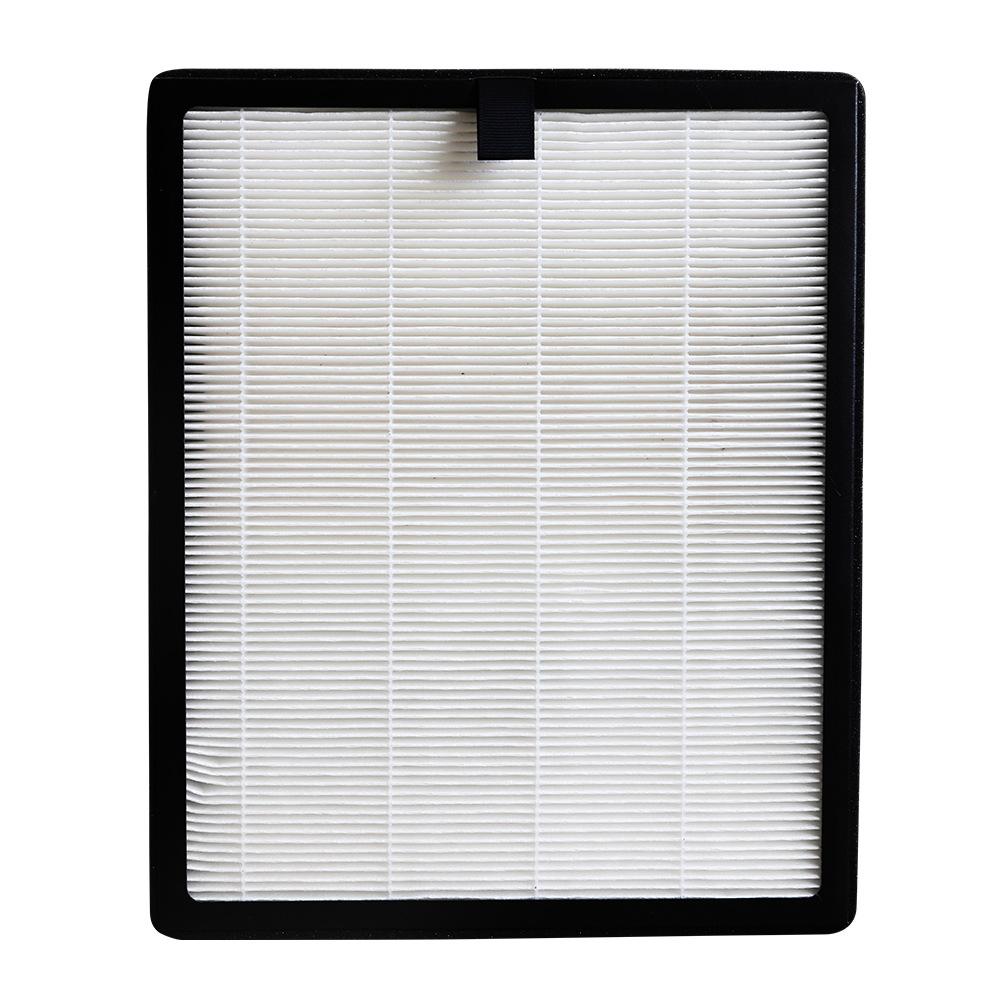 HEPA H13 Replacement Filter for Standard PurifiersThis HEPA H13 replacement filter captures 99.97% of particles as small as 0.3 microns, including dust, pollen, smoke, and bacteria, ensuring clean air output and maintaining your purifier's performance.View Product →
Beyond HEPA: Activated Carbon and Cold Catalyst Layers
HEPA alone does not remove chemical vapors. Particulates and gases are different worlds. Smoke, cooking odors, formaldehyde, and volatile organic compounds need an adsorption or catalytic layer. This is where many budget filters fail: they include a thin dusting of carbon granules that saturates within weeks.
Activated carbon works by trapping odorous molecules inside its porous structure. A filter with a thick carbon layer and high iodine value keeps absorbing smells for months. Cold catalyst media takes a different route: it breaks down formaldehyde and other gases at room temperature through a catalytic reaction. Both approaches matter if your air quality problem is chemical rather than particle-driven.
An OEM cold catalyst filter media extends your existing purifier without changing the fan or housing, turning a simple particle cleaner into a more complete air treatment system for low-grade chemical pollution.
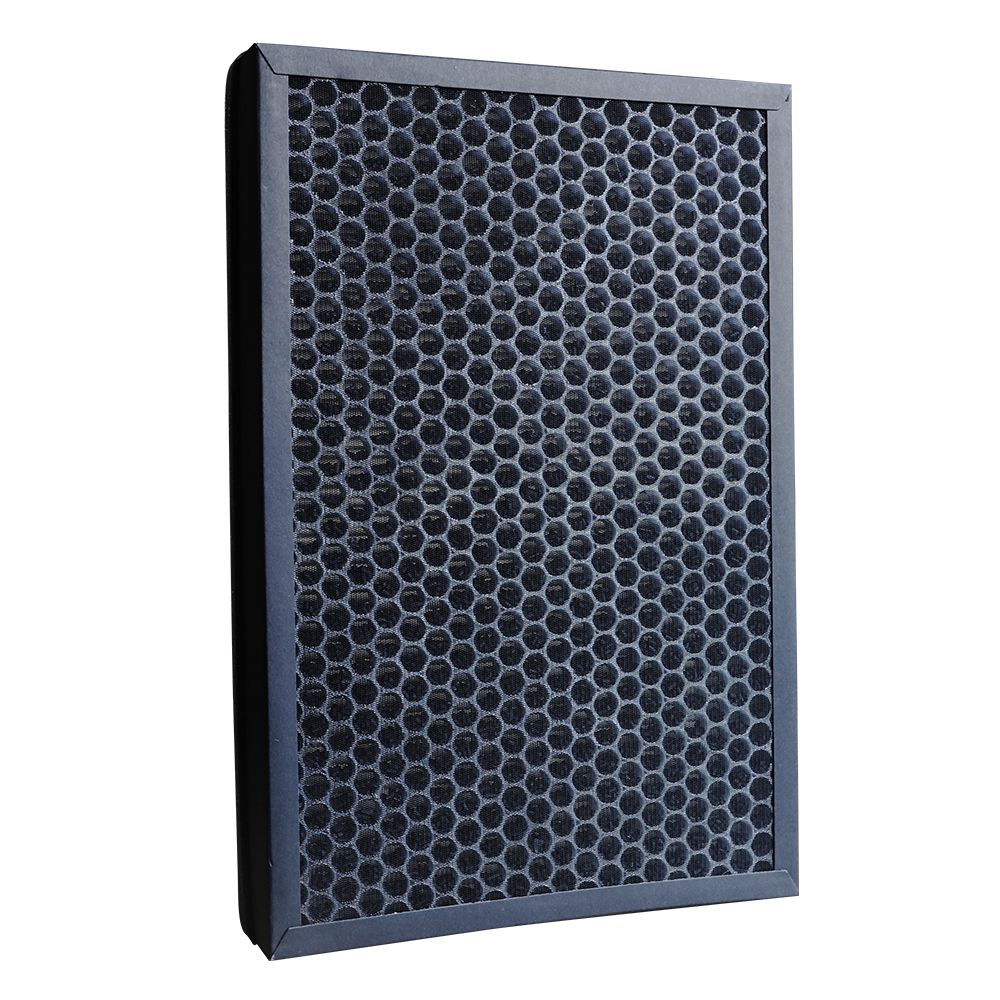 OEM Cold Catalyst Filter for Chemical PollutionThis OEM cold catalyst filter decomposes formaldehyde, ammonia, TVOC, and other harmful gases, turning your existing purifier into a more complete air treatment system without changing the fan or housing.View Product →
How to Choose the Right Filter for Your Purifier
First, match the filter to your machine's rated airflow. The CADR of a purifier is only meaningful if the filter seals properly. An undersized filter with a gap lets air slip around it, bypassing the media while inflating noise and reducing clean air output. Dimensional tolerance for height, width, and thickness typically sits within 1-2 mm.
Second, decide on pleat count and depth. A deeper pleat pack has larger surface area, which means a lower pressure drop and a longer filter life. Third, check the frame and edge sealing. Reinforced frames prevent air leaks and keep the filter rigid over months of operation.
| Room Area | Recommended CADR | Filter Replacement |
|---|---|---|
| 10 m² | 120 m³/h | 6-9 months |
| 20 m² | 240 m³/h | 4-6 months |
| 30 m² | 360 m³/h | 4-6 months |
| 40 m² | 480 m³/h | 3-4 months |
For compact purifiers where the airflow path runs through a cylindrical cartridge, a round H13 HEPA filter for air purifiers preserves the full media depth in a small footprint while maintaining a tight seal.
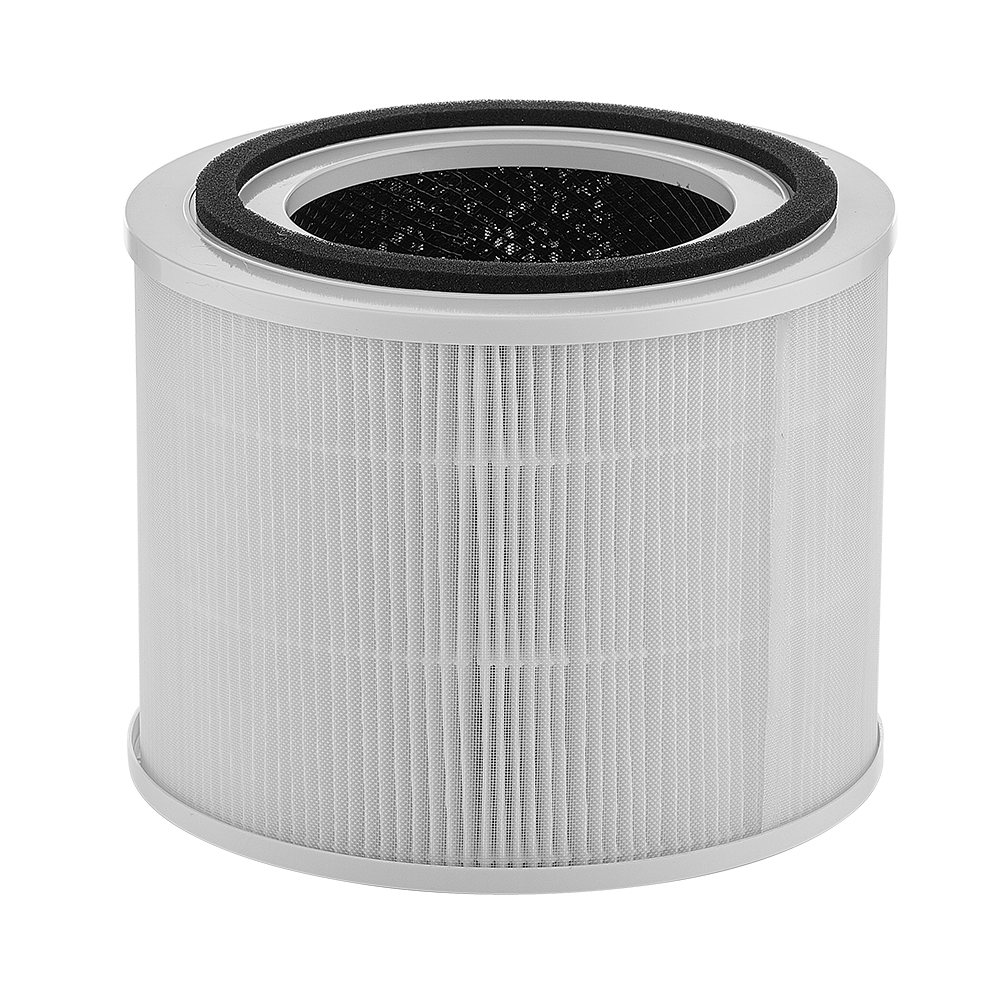 Round HEPA H13 Filter for Compact PurifiersThis round HEPA H13 filter, combining HEPA with activated carbon honeycomb, removes dust, pollen, and odors while capturing 99.97% of particles down to 0.3 microns in a compact design.View Product →
When to Replace Your Air Filter
Plan on changing the filter every six months for continuous daily use. If you run the purifier only a few hours each evening, twelve months is possible, but the carbon layer gives up earlier than the HEPA. A loaded carbon filter stops adsorbing once its pores fill, and it can even release trapped odors as the air warms and cools.
Signs that replacement is due include rising fan noise, noticeably weaker airflow, or a musty smell from the outlet. Some smart purifiers display filter-life indicators, but a basic light test works fine: hold the filter up to a lamp. The pleats should still let light through relatively evenly.
Keeping true HEPA filter replacements ready means you do not have to run the machine with a clogged filter while you compare online listings.
A Closer Look at Filter Construction
A well-built filter is a multi-layer sandwich. Starting from the air-intake side, a coarse prefilter catches hair, pet fur, and large dust. The HEPA pleat pack follows, capturing fine particles down to 0.3 microns. Next comes a bonded activated carbon layer that adsorbs odors and VOCs. Finally, a cold catalyst surface decomposes residual formaldehyde, releasing cleaner air on the exhaust side.
Each layer handles a separate class of pollutants. If you buy a filter that skips the prefilter, the HEPA will clog faster. If it has no carbon layer, odors return as soon as the HEPA is clean. Understanding this construction helps you evaluate competing products at a glance.
Frequently Asked Questions About Air Filters
Q1: How often should I replace the HEPA filter in my air purifier?
Most manufacturers recommend every 6 to 12 months. If you run the unit daily in a high-dust area or with pets, replace it every 6 months.
Q2: Is an H13 filter better than an H11?
Yes. H13 captures 99.97% of particles at 0.3 microns, while H11 is around 95%. For allergy or respiratory concerns, H13 is worth the extra cost.
Q3: Can I wash a HEPA filter?
No. Washing destroys the fiber structure. You can gently vacuum the prefilter, but the pleated HEPA media must be replaced when clogged.
Q4: What does the activated carbon layer remove?
It adsorbs smoke, kitchen smells, pet odors, and VOCs. It does not capture particles, so it works alongside HEPA, not instead of it.
Q5: How do I know which filter size to buy?
Check the model number on the old filter or the purifier housing. Height, width, and thickness tolerances must be within about 2 mm for proper sealing.
Q6: What happens if I never change the filter?
The purifier becomes a dust pump. It releases trapped particles back into the air, the fan works harder, and the motor may overheat.