EN
EN
 English
 中文简体
中文简体
.png)
A 5.5 L air fryer feels generous in the shop and cramped the first time four people sit down to eat. That single mismatch, between the capacity printed on the box and the food you actually cook, sits behind a large share of disappointing purchases in this category.
Here is the short answer before the detail: choose capacity first, then the control type, then the basket coating and food-contact materials. Rated wattage is a tiebreaker, not a headline. And treat any claim about crispness that does not tell you how much food fits in a single layer with suspicion.
The sections below follow that order of importance, with the numbers, trade-offs and checks that separate a well-matched appliance from a return.
Content
- 1 Match Basket Capacity to Real Portions, Not to the Box
- 2 Wattage, Airflow and Basket Shape: What Actually Cooks the Food
- 3 Controls and Cleaning: Where Daily Frustration Comes From
- 4 Safety, Materials and Manufacturing Standards
- 5 A One-Minute Buying Checklist
- 6 Frequently Asked Questions
- 6.1 Q1. What air fryer capacity do I need for a family of four?
- 6.2 Q2. Is an air fryer healthier than deep frying?
- 6.3 Q3. How much electricity does an air fryer use?
- 6.4 Q4. Do I really need a dual basket air fryer?
- 6.5 Q5. Can the air fryer basket go in the dishwasher?
- 6.6 Q6. Why does food come out soggy instead of crispy?
Match Basket Capacity to Real Portions, Not to the Box
The litre figure describes the total volume of the drawer, not the volume you can cook in. Food has to sit below the top edge of the tray, ideally in a single layer, because the fan needs a clear path for hot air to move around every piece. Fill a 5.5 L basket to the brim and you have effectively built a slow, uneven oven with a hot lid.
| Basket size | Best suited to | Typical single-batch output | Counter footprint |
|---|---|---|---|
| 1.8 L to 2 L | One person, sides, reheating | 1 to 2 portions | Smallest, fits under a wall cabinet |
| 3.5 L to 4 L | Couples, small kitchens | 2 to 3 portions | Around 30 x 25 cm |
| 5.5 L to 6.5 L | Families of three to four | 3 to 4 portions | Around 35 x 30 cm |
| 8 L or dual basket | Families of five and batch cooking | 5 to 6 portions | Around 40 x 35 cm |
| 12 L to 15 L oven style | Large households, whole meals | 8 or more portions | Shelf-sized cabinet |
As a working rule, a 3.5 L to 4 L unit cooks comfortably for two and stretches to three if you accept two short batches. A 5.5 L to 6.5 L basket is the practical sweet spot for a family of four. Larger households, or anyone who batch-cooks for the week, should look at 8 L class machines, dual-basket designs, or an oven-style 12 L to 15 L cabinet that can take a whole chicken. When the counter is the real constraint, compact mini air fryers in the 1.8 L to 2 L range handle single servings, sides and reheating without claiming a shelf.
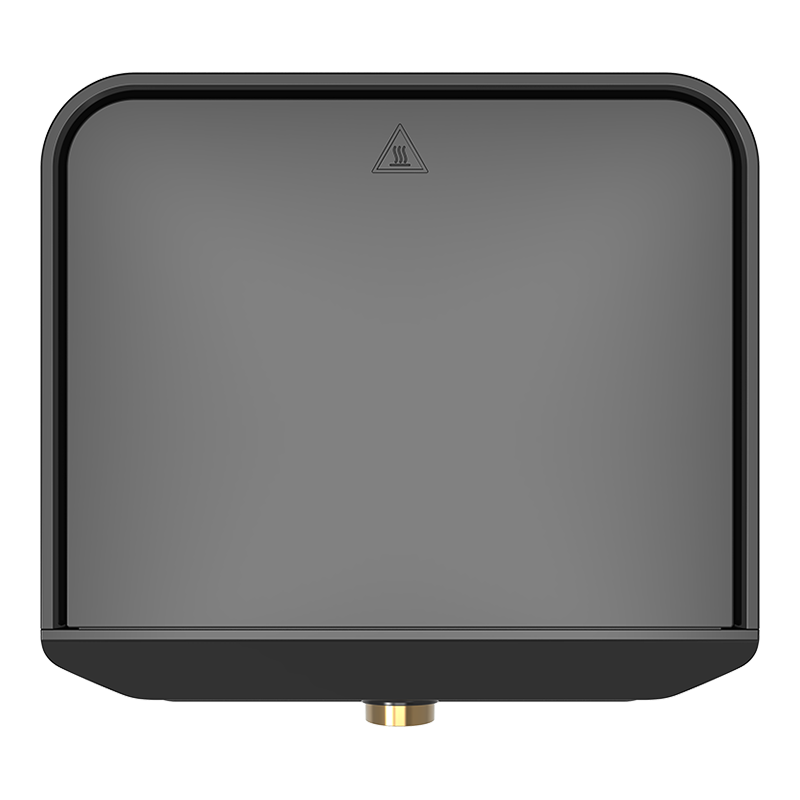 Large Capacity 15L Digital Home Air Fryer with Sliding DoorA 15 L single-pot digital air fryer with sliding door, 0–30 minute timer and automatic shut-off, suited to large batches and family-sized cooking.View Product →
Two sizing traps are worth naming. First, tall narrow drawers hold less usable area than short wide ones of identical volume, so compare tray dimensions rather than litres alone. Second, a dual-basket machine gives you two smaller zones, not one large one: a 2 x 4 L unit is not the same as an 8 L unit when you want to roast a whole chicken or bake a tray of vegetables in one pass.
Wattage, Airflow and Basket Shape: What Actually Cooks the Food
An air fryer is a compact convection oven. A top-mounted element heats the air, a fan drives it down through the basket, and a perforated tray lets it return upward. Cooking quality follows from that loop, and three parts control it: the fan and duct design, the tray hole pattern, and the clearance between food and element.
Typical rated power by basket size
Indicative ranges taken from current manufacturer specification sheets.
Rated power mostly determines how fast the cavity recovers temperature after you open the drawer or add cold food. Moving from 1400 W to 1800 W shaves a couple of minutes off preheating and helps when the basket is full, but it will not rescue a basket that blocks airflow. Temperature stability matters more in daily use: a machine holding within roughly 5 to 10 degrees Celsius of the set point gives repeatable results, while one that swings 30 degrees browns the edges before the centre cooks through. Look for a published range of about 80 to 200 degrees Celsius and presets you will genuinely use.
The closed loop between element, fan, basket and tray is what crisps food without deep oil.
Shape and finishing matter too. Perforated flat trays crisp better than solid bases because moisture drains away instead of steaming the underside. Rounded or square corners matter far less than total usable area. And a non-stick layer applied too thinly will flake within a year of metal-tong use, which is a materials question rather than a cooking one.
Controls and Cleaning: Where Daily Frustration Comes From
This is the second decision after capacity, because it shapes how the appliance feels every single evening.
Mechanical dials versus digital panels
Knob control has two moving parts and almost nothing to fail. For a 3.5 L machine used for the same handful of dishes, a mechanical panel with a 30-minute timer and a temperature dial is the more durable and usually cheaper choice, and it is simpler for guests or older family members to operate. Digital touch panels buy exact temperature steps, preset programs, keep-warm modes and longer timers, which pay off if you bake, dehydrate and cook fish in the same appliance. The trade-off is a membrane keypad that dislikes greasy fingers and steam. A knob-control model such as the 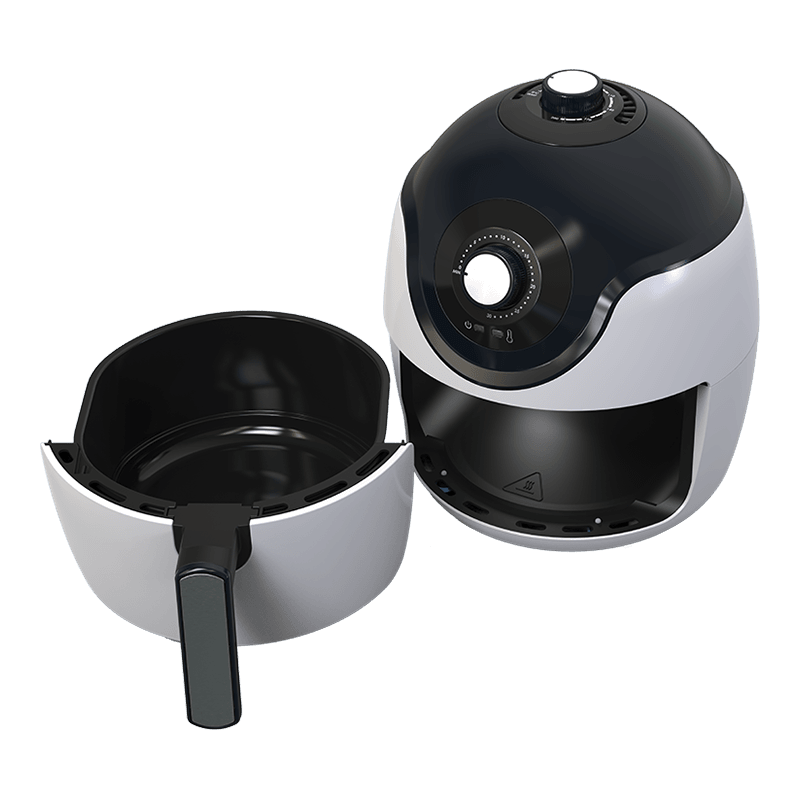 3.5L Medium Capacity Air Fryer with 30-Minute Timer and Temperature DialA compact 3.5 L air fryer with Teflon non-stick tank, 30-minute timer, 80–200°C dial, and stainless steel heating element for everyday cooking.View Product → 3.6 L class unit covers the everyday reheating and crisping jobs without a control board to replace.
Coating, dishwasher safety and hard-to-reach crevices
Check three things before paying: whether the basket and tray come out without tools, whether both are rated for the dishwasher, and whether the element cover can be wiped clean. A pull-out drawer with one removable basket remains the easiest design to wash. Visual-window air fryers let you watch browning without opening the drawer, which cuts heat loss and shortens total cooking time, while a hinged oven-style door handles large batches but is fussier to clean around the gasket. If you want finer temperature control and presets, a digital touchscreen model such as the 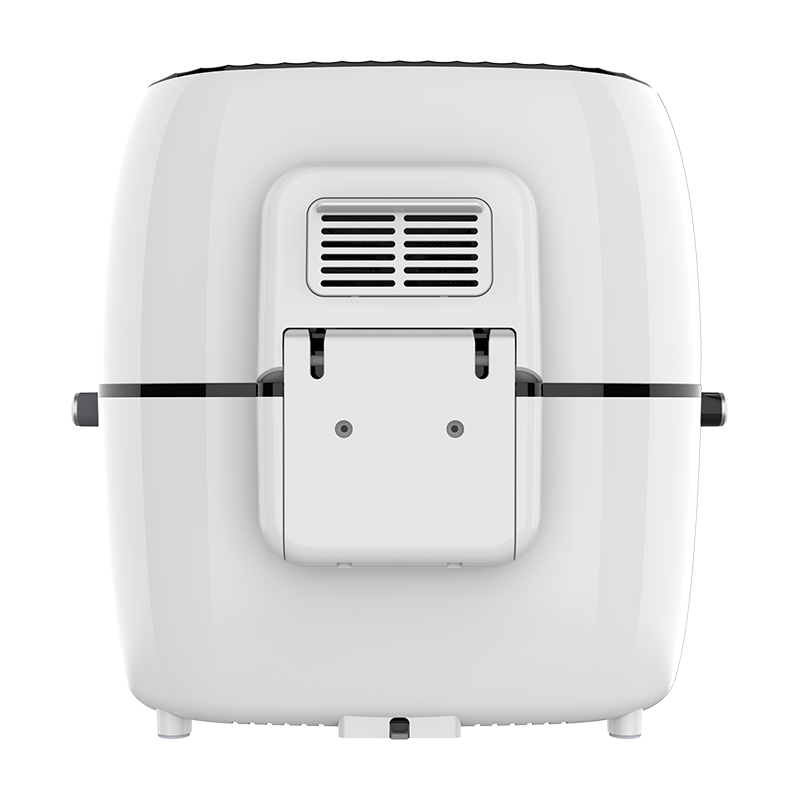 6.5L Touch Panel Electric Air Fryer with Eight Smart MenusA 6.5 L touch-panel air fryer with eight smart menus, adjustable temperature and overheat protection, positioned as a mid-size digital step up for varied cooking.View Product → 6.5 L class unit is a reasonable mid-size step up.
Safety, Materials and Manufacturing Standards
Cooking performance claims mean little if the plastics and coatings are uncontrolled. Practical checks include automatic shut-off when the drawer is removed and when the timer ends, a handle that stays cool after 20 minutes at 200 degrees Celsius, and food-contact surfaces declared free of BPA and heavy-metal stabilisers. Ceramic non-stick and stainless steel carry different trade-offs: ceramic releases food well but loses that release over time, while stainless steel is inert, dishwasher-proof and needs a little oil to prevent sticking.
At factory level, two signals are worth asking for when you compare suppliers or private-label programmes: ISO certified manufacturing and a documented test laboratory. Voltage and plug type must also match your market, which matters more for importers than for local buyers. Air fryers typically run at 55 to 65 decibels, so a unit that hums noticeably louder is usually a sign of a weaker fan assembly rather than more power.
- Non-stick adhesion and coating thickness rather than colour
- Automatic shut-off and overheat protection
- Cool-touch handle after a full high-temperature cycle
- Food-contact materials declared BPA-free
- Voltage and plug type matched to the destination market
A One-Minute Buying Checklist
- Measure the counter space and the gap under the wall cabinet first.
- Set capacity from the number of portions you cook, not from the price.
- Compare tray dimensions and single-layer area, not just litres.
- Pick the control type from the dishes you cook, not from the look of the panel.
- Confirm the basket and tray are removable and dishwasher safe.
- Verify shut-off, cool-touch handle and food-contact material declarations.
- Compare wattage last, once everything above already fits.
Three common mistakes account for most returns: buying a capacity you will never fill, choosing a dual-basket design for single-dish cooking, and ignoring how much of the basket is actually usable once the tray is in place. Fix those and the rest of the specification list becomes easy to read.
Frequently Asked Questions
Q1. What air fryer capacity do I need for a family of four?
A 5.5 L to 6.5 L basket is the practical answer for four people, provided you cook in one layer. If you regularly cook for five or more, or batch-cook, step up to 8 L or an oven-style 12 L cabinet.
Q2. Is an air fryer healthier than deep frying?
Yes in terms of added oil: an air fryer typically needs a tablespoon or less for a tray of food, while deep frying submerges it in litres of oil. The appliance does not remove fat already inside the food, so results still depend on the recipe.
Q3. How much electricity does an air fryer use?
Most home models draw between 1400 W and 1800 W. A 30-minute session at 1700 W uses roughly 0.85 kWh, which is usually less than heating a full-size oven for the same dish because the cavity is far smaller.
Q4. Do I really need a dual basket air fryer?
Only if you cook two different foods at different temperatures at the same time. Otherwise the two smaller zones limit you more than they help, and a single larger basket gives more usable cooking area for the same counter footprint.
Q5. Can the air fryer basket go in the dishwasher?
Many non-stick baskets and trays are dishwasher safe, but check the manual first. Hand washing with warm water and a soft sponge protects the coating longer, especially on ceramic and thin non-stick finishes.
Q6. Why does food come out soggy instead of crispy?
Almost always overcrowding. When pieces overlap, moisture cannot escape and hot air cannot circulate. Cook in a single layer, pat food dry, add a light oil coating, and shake the basket halfway through.