EN
EN
 English
 中文简体
中文简体
.png)
Choosing a medical air purifier for a hospital or clinic comes down to five non-negotiable criteria: filtration efficiency (True HEPA H13 or higher), air changes per hour (ACH) matched to room volume, low noise output below 55 dB(A), compliance with ISO 9001 and relevant medical equipment standards, and a verifiable CADR (Clean Air Delivery Rate) appropriate for the clinical zone being served. A device that meets all five criteria will significantly reduce airborne pathogen load, protect immunocompromised patients, and help infection control teams maintain regulatory-compliant indoor air quality. This guide explains each criterion in practical depth and provides the evaluation framework procurement teams need.
Indoor air quality in clinical environments is not a comfort issue — it is a patient safety issue. The WHO estimates that healthcare-associated infections (HAIs) affect 7 in every 100 hospitalized patients in high-income countries and 10 in every 100 in low- and middle-income countries, with a meaningful proportion transmitted via airborne or droplet routes. A properly specified HEPA air purifier for hospital environments is one of the most evidence-backed engineering controls available for reducing this transmission risk.
Content
- 1 What Is a Medical Air Purifier and How Does It Differ from Standard Units?
- 2 HEPA Filter Grade Comparison: Particle Capture Efficiency
- 3 Understanding ACH: How Many Air Changes Per Hour Does Your Space Need?
- 4 Key Technical Criteria for Selecting a Medical-Grade Air Purifier
- 5 Medical vs Home Air Purifier: Performance Radar Comparison
- 6 Airborne Pathogen Reduction: Measured Outcomes in Clinical Settings
- 7 Room-by-Room Deployment Guide: Matching Units to Clinical Zones
- 8 OEM and Wholesale Sourcing: What to Expect from a Qualified Manufacturer
- 9 Frequently Asked Questions
What Is a Medical Air Purifier and How Does It Differ from Standard Units?
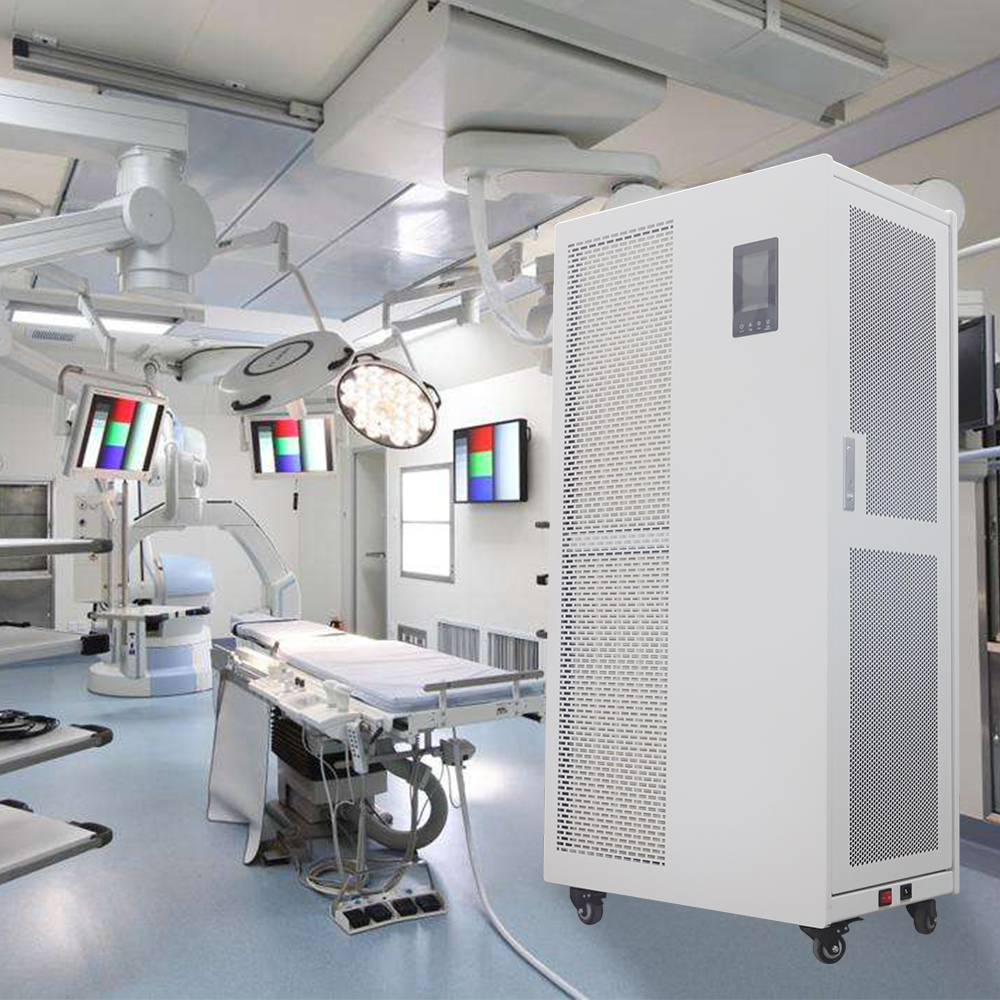
A medical air purifier is a commercial medical air purifier system specifically engineered to meet the filtration, safety, and operational continuity demands of healthcare settings. Understanding the distinctions from consumer units helps purchasing teams avoid common specification errors that result in devices that look clinical but perform at residential grade.
| Feature | Medical Air Purifier | Standard Home Unit |
|---|---|---|
| HEPA Standard | H13 or H14 (99.95–99.995%) | H11 or H12 (95–99.5%) |
| CADR Rating | 300–800+ m³/h | 80–250 m³/h |
| ACH Capability | 6–12+ ACH in target room | 2–4 ACH in typical room |
| UV-C / Disinfection Layer | Often included (254nm UV-C) | Rarely included or under-powered |
| Noise Level | <55 dB(A) at max fan speed | 50–70 dB(A) at max |
| Continuous Operation | Rated for 24/7 continuous use | Typically intermittent use rated |
| Certifications | ISO 9001, medical device registration | CE, FCC (consumer grade) |
| Filter Life Monitoring | Real-time sensor with alerts | Timer-based indicator only |
The H13 HEPA standard is the critical dividing line. An H13 filter captures at least 99.95% of particles at 0.3 microns — the most penetrating particle size (MPPS) — including bacteria, most viruses when attached to aerosol droplets, and fine particulate matter. An H11 filter found in many home units captures only 95% of the same particles, meaning 5% bypass — a figure that sounds small but translates to millions of particles per hour in a busy clinical corridor.
HEPA Filter Grade Comparison: Particle Capture Efficiency
The horizontal bar chart below illustrates the minimum filtration efficiency at 0.3 microns for each HEPA grade classification per the EN 1822 standard. The gap between H11 and H13 appears small in percentage terms but represents an order-of-magnitude difference in the number of particles that bypass the filter — a distinction with direct clinical consequences in infection-sensitive zones.
HEPA classification efficiency thresholds per EN 1822; H13 and H14 are the minimum acceptable grades for medical facility deployment.
For infection control purposes, H13 is the practical minimum for waiting rooms, patient wards, and general clinical areas. H14 is warranted in surgical theaters, isolation rooms, and immunocompromised patient units where the consequences of any filtration bypass are most severe. The gap between H13 and H14 — from 99.95% to 99.995% efficiency — means H14 allows just one particle through for every ten that bypass H13, a meaningful difference in the highest-risk environments. When evaluating a hospital air purifier supplier, always request the EN 1822 or IEST RP-CC001 test certificate for the specific filter model, not a generic HEPA claim.
Understanding ACH: How Many Air Changes Per Hour Does Your Space Need?
Air changes per hour (ACH) is the measure of how many times per hour the entire volume of air in a room passes through the purifier's filtration system. The CDC and ASHRAE recommend a minimum of 6 ACH for general patient care areas, 12 ACH for airborne infection isolation rooms (AIIRs), and 15–20 ACH for operating theaters (Source: CDC Guidelines for Environmental Infection Control in Health-Care Facilities, 2003, updated 2019). The column chart below shows recommended ACH levels by clinical zone.
Source: CDC Guidelines for Environmental Infection Control in Health-Care Facilities (2003, updated 2019) and ASHRAE Standard 170.
To calculate the required CADR for your space: multiply the room volume in cubic meters by the target ACH, then divide by 60 to get the required airflow in cubic meters per minute. For example, a 50m² consultation room with 3m ceilings (150 m³) targeting 6 ACH requires a CADR of at least 15 m³/min (900 m³/h). Most single-unit clean air purifier systems for clinical spaces range from 300 to 800 m³/h, meaning some larger or high-ACH zones require multiple units or a ducted solution. Always size for the clinical zone's requirements — not for the maximum room the unit can handle at minimum fan speed.
Key Technical Criteria for Selecting a Medical-Grade Air Purifier
Filtration Technology Stack
A clinical-grade air filtering system should incorporate multiple filtration stages in sequence. Pre-filters capture large particles and extend HEPA filter life. The H13 HEPA core handles sub-micron particles and pathogens. An activated carbon stage adsorbs volatile organic compounds (VOCs), anesthetic gases, and odors generated in clinical settings. UV-C germicidal irradiation at 254nm inactivates microorganisms captured on or passing through the filter matrix, providing a kill step rather than simple capture. Some advanced units add photocatalytic oxidation (PCO) to break down VOCs at the molecular level. The combination of mechanical filtration, UV-C, and activated carbon delivers the multi-barrier protection that infection control protocols demand.
Noise Output: Clinical Environments Have Strict Limits
WHO guidelines recommend background noise in hospital patient rooms not exceed 35 dB(A) at night and 40 dB(A) during the day (Source: WHO Environmental Noise Guidelines for the European Region, 2018). A medical air purifier running at maximum fan speed in a small room can easily exceed these thresholds with poorly designed fan assemblies. Specify units with a documented noise level below 55 dB(A) at maximum speed and below 40 dB(A) at low speed — the setting at which most units will operate during occupied hours. EC (electronically commutated) brushless motors provide quieter operation and longer service life than conventional AC motor designs.
How Often to Change Air Purifier Filters in Medical Settings
How often to change air purifier filters in a clinical environment depends on operating hours, airborne particle load, and filter type. As a general framework: pre-filters in high-traffic clinical areas should be inspected monthly and replaced every 1–3 months. H13 HEPA filters typically require replacement every 12–18 months under continuous operation at rated airflow. Activated carbon filters in rooms with significant VOC sources (operating rooms, dental offices) may require replacement every 6–12 months. UV-C lamps lose 50% of their germicidal output after approximately 8,000–10,000 hours of operation and should be replaced on a scheduled basis regardless of visible light output. Medical facilities should insist on units with real-time filter saturation sensors and pressure drop monitoring that alert maintenance teams before performance degrades — not after.
Certifications and Documentation Requirements
For hospital procurement, documentation is as important as performance. Require the following from any medical grade air purifier factory or supplier before purchase:
- ISO 9001 quality management system certificate for the manufacturing facility
- EN 1822 filter test certificate for the specific HEPA filter model used in the unit
- CADR test report from an accredited third-party laboratory
- Medical device registration certificate or equivalent national regulatory clearance
- Electrical safety certification (CE, UL, or market-appropriate equivalent)
- OEM customization capability documentation if custom configurations are required
Medical vs Home Air Purifier: Performance Radar Comparison
The radar chart below compares medical-grade and standard home air purifiers across six performance dimensions that matter most in clinical procurement decisions. The comparison illustrates why simply deploying hepa air purifiers marketed for home use in clinical settings creates performance gaps that conventional purchasing processes may miss entirely.
Comparative performance profile across six clinical procurement criteria; values represent relative capability ratings, not absolute measurements.
The performance gap is most pronounced in filtration grade, CADR/ACH capability, and certification depth — precisely the three dimensions that infection control protocols prioritize. Home units designed as air purifier home products are optimized for consumer convenience, quiet operation during sleep, and aesthetic design rather than for continuous clinical deployment at high airflow rates with documented pathogen reduction performance. This does not make them inferior products in their intended context — it simply means they serve a different application, and substituting one for the other creates documented clinical risk.
Airborne Pathogen Reduction: Measured Outcomes in Clinical Settings
Evidence for the effectiveness of medical air purification in reducing airborne pathogen load is well established. The line chart below models the reduction in airborne colony-forming units (CFU/m³) over a 60-minute period in a 30m² room at various ACH levels, illustrating how purifier sizing directly determines the speed and completeness of pathogen clearance. Studies in clinical settings have demonstrated that HEPA-based air filtration can reduce airborne SARS-CoV-2 RNA concentrations by more than 90% within 60 minutes of operation (Source: Curtius et al., 2021, ERJ Open Research).
Modeled airborne particle clearance curves based on exponential decay equations at stated ACH levels; real-world results vary with room geometry, occupancy, and particle source rate. Reference: Curtius et al., ERJ Open Research, 2021.
At 12 ACH, over 97% of initial airborne load is cleared within 30 minutes — the CDC threshold for an airborne infection isolation room. At 6 ACH, it takes the full 60 minutes to achieve comparable clearance, and 2 ACH reduces load by only about 60% over the same period. This data has direct implications for procedural timing in settings like bronchoscopy suites and dental offices where AGPs (aerosol-generating procedures) create sudden high-concentration exposure events. The purifier does not just maintain steady-state air quality — it also determines how quickly the room recovers after an exposure event, which is the clinically critical measure.
Room-by-Room Deployment Guide: Matching Units to Clinical Zones
Different clinical zones have distinct air quality challenges that require tailored solutions. The following table provides a practical deployment framework for the most common hospital and clinic environments.
| Clinical Zone | Min. ACH | Key Contaminants | Required Features |
|---|---|---|---|
| Waiting Room | 4–6 | Respiratory aerosols, viruses | H13 HEPA, PM2.5 sensor, quiet operation |
| Consultation Room | 6 | Respiratory droplets, VOCs | H13 HEPA, activated carbon, <45 dB(A) |
| General Ward | 6–8 | Multi-patient aerosols, odors | H13 HEPA, carbon, 24/7 rated, remote monitoring |
| Dental Office | 8–10 | Aerosols from AGPs, blood aerosol | H13 HEPA, UV-C, high CADR, near-source placement |
| Isolation Room (AIIR) | 12 | TB, SARS, measles aerosols | H14 HEPA, UV-C, redundant fan, negative pressure capable |
| Operating Theater | 20+ | Surgical smoke, anesthetic gases, bacteria | Laminar flow HEPA, carbon, cleanroom integration |
| Oncology / BMT Unit | 12–25 | Fungal spores, bacteria, fine particles | H14 HEPA, positive pressure, spore-rated pre-filter |
OEM and Wholesale Sourcing: What to Expect from a Qualified Manufacturer
Healthcare procurement teams and distributors sourcing clinic air purifier OEM supplier partnerships or wholesale medical air purifiers at scale should evaluate manufacturers on criteria beyond price and lead time. The following capabilities distinguish a factory operating at medical equipment standards from a general consumer appliance producer:
- In-house testing laboratory: A facility with its own filtration efficiency testing equipment, airflow measurement rigs, and electrical safety test benches can validate production quality without relying on batch-sample third-party testing, which catches defects too late in the production cycle.
- ISO 9001 certified quality management: This certification ensures documented processes for design control, supplier qualification, inspection, and corrective action — the infrastructure that makes consistent quality across large production volumes achievable.
- Production scale for variable order quantities: Medical facilities range from single-room clinics to multi-building hospital campuses with hundreds of installed units. A qualified factory should accommodate both small-quantity pilot orders and large-scale rollouts without quality compromises at either scale.
- OEM customization depth: Custom branding, modified control interfaces, alternative filter configurations, and integration with hospital BMS (building management systems) are legitimate requirements for large healthcare system procurement — the manufacturer should demonstrate engineering capability to fulfill these rather than offering only catalog products.
Ningbo Yinyu Purification Technology Co., Ltd. operates as a professional China medical air purifier manufacturer and OEM medical air purifier factory, integrating production and trade across household appliance, medical equipment, and disinfection equipment categories. With ISO 9001 certification, an in-house testing laboratory with advanced inspection equipment, and an annual production capacity exceeding 300,000 units, Yinyu is structured to serve both institutional procurement teams requiring large-volume consistency and distributors needing flexible OEM customization. Products are suitable for both clinical deployment and high-performance home air filtration applications where medical-grade standards are desired.
Frequently Asked Questions
Q1: What is a medical air purifier?
A medical air purifier is a filtration system engineered to meet the airborne infection control requirements of clinical environments. It typically incorporates an H13 or H14 HEPA filter, activated carbon for VOC and odor control, UV-C germicidal irradiation, and a motor rated for continuous 24/7 operation — with documented CADR values and regulatory certifications that standard home units do not carry.
Q2: How is a medical air purifier different from a normal one?
The key differences are filtration grade (H13/H14 vs H11/H12), CADR capacity (typically 3–5× higher), continuous-use motor ratings, independent certification to medical device standards, and real-time filter saturation monitoring. Medical units are also constructed with materials that withstand hospital-grade cleaning agents without degradation.
Q3: Do hospitals use air purifiers?
Yes — hospitals use both fixed HVAC-integrated HEPA filtration and portable standalone medical air purifiers. Portable units are particularly valuable in spaces where HVAC upgrades are not feasible, for supplemental ACH in high-risk zones, and during renovation projects where construction dust and spores must be controlled to protect vulnerable patients.
Q4: What makes an air purifier "medical grade"?
A medical-grade air purifier uses an H13 or H14 HEPA filter verified by EN 1822 testing, has a CADR sufficient to achieve 6+ ACH in its target clinical space, is rated for continuous operation, carries applicable medical device or safety certifications, and provides documented performance data rather than marketing claims. ISO 9001 manufacturing certification is an additional quality indicator.
Q5: Are HEPA filters enough for medical air purification?
H13 HEPA filtration is the mechanical core of clinical air purification and handles bacteria, most viruses on aerosol carriers, and fine particulate matter effectively. However, for complete protection — including VOC removal, odor control from clinical chemicals, and active pathogen inactivation rather than just capture — combining HEPA with activated carbon and UV-C germicidal irradiation is the more complete and defensible solution for healthcare environments.
Q6: What does an air purifier help with in a clinical setting?
In clinical settings, a properly specified air purifier reduces airborne pathogen concentration (including bacteria, fungi, and virus-laden aerosols), removes fine particulate matter (PM2.5 and PM10), eliminates VOCs from cleaning agents and anesthetic gases, controls odors in patient care areas, and contributes to regulatory compliance with indoor air quality standards. It works as an active engineering control alongside hand hygiene and PPE in infection prevention programs.