EN
EN
 English
 中文简体
中文简体
.png)
Content
- 1 Can Air Purifiers Purify the Air
- 2 How Air Purifiers Actually Clean Air
- 3 Understanding HEPA H13 and H14 Medical Grade Filtration
- 4 Can Air Purifiers Remove Viruses and Airborne Pathogens
- 5 Sizing an Air Purifier for Healthcare and Hospital Spaces
- 6 How Quickly a Purifier Reduces Particle Counts
- 7 Medical Grade Versus Standard Household Air Purifiers
- 8 Where Medical Air Purifiers Are Used
- 9 Filter Replacement and Ongoing Maintenance
- 10 Sourcing Medical Air Purifiers From a Manufacturing Company
- 11 Frequently Asked Questions
- 11.1 What Is a Medical Air Purifier
- 11.2 How Do Medical Air Purifiers Work
- 11.3 Are HEPA Air Purifiers Effective in Hospitals
- 11.4 Can Air Purifiers Remove Viruses
- 11.5 What Is a Medical Grade HEPA Filter
- 11.6 Do Hospitals Use Air Purifiers
- 11.7 What Is the Difference Between HEPA H13 and H14
- 11.8 How Often Should HEPA Filters Be Replaced
- 11.9 Are UV Air Purifiers Safe
- 11.10 What Size Air Purifier Does a Hospital Need
Can Air Purifiers Purify the Air
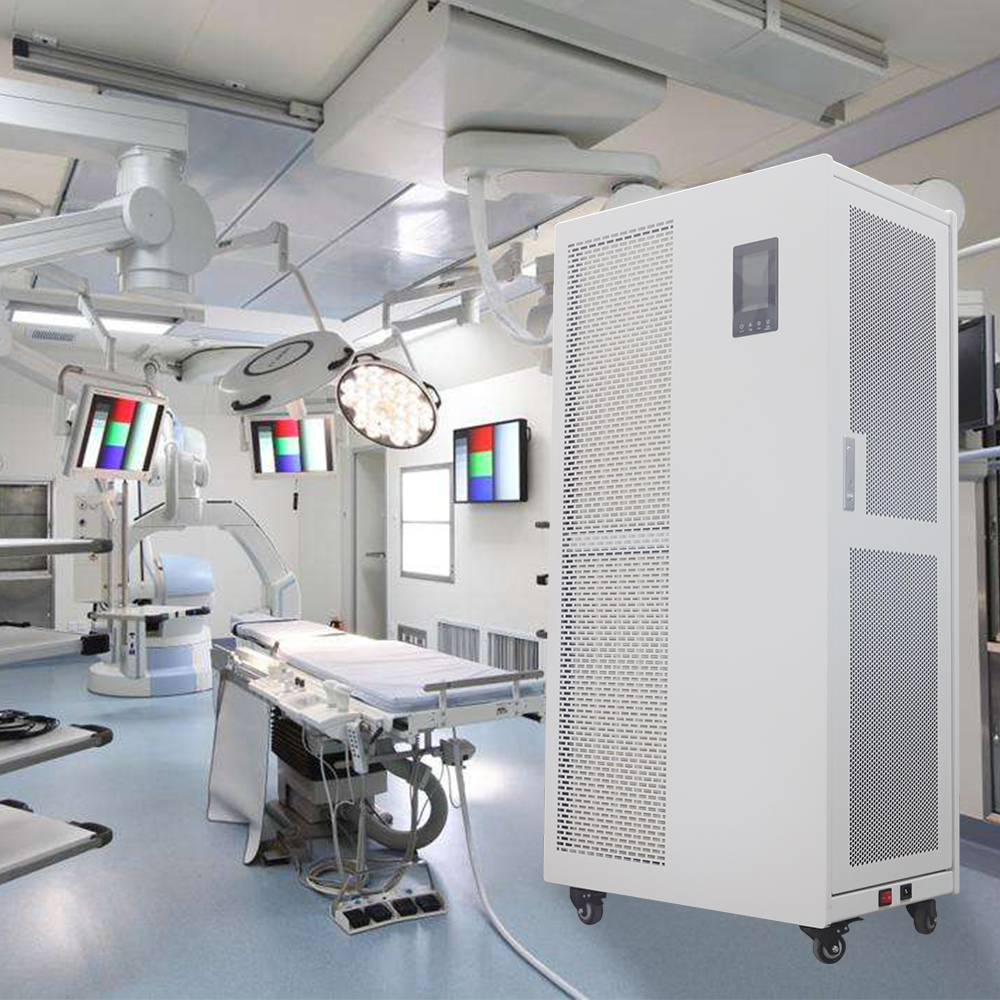
Yes, air purifiers can meaningfully reduce airborne particles, allergens, dust, and certain airborne pathogens when the unit is correctly sized for the room and fitted with a suitable filter. A Medical Air Purifier equipped with medical grade HEPA filtration is designed to capture very fine particles, including many bacteria and virus carrying droplets, as air repeatedly passes through the filter media. What an air purifier cannot do is replace proper ventilation, ductwork balancing, or surface disinfection, since it only treats particles that are actually drawn through the unit.
The practical answer depends heavily on filter grade, airflow rate, and how often the unit cycles the air in a given room. A small desktop purifier will do little for a large ward, while a properly sized Medical Purifier placed in a treatment room or isolation space can noticeably lower particle counts within a short period. The sections below walk through how filtration actually works, how HEPA grades compare, how quickly particle counts fall after a unit is switched on, and how to think about sizing for healthcare and household spaces alike.
How Air Purifiers Actually Clean Air
Most air purifiers pull room air through a sequence of filter stages rather than a single filter layer. A pre-filter captures large particles such as hair, lint, and coarse dust, which protects the finer filter stages downstream from clogging too quickly. Behind the pre-filter sits the main filtration layer, most often a HEPA filter, which captures the vast majority of small airborne particles including pollen, mold spores, fine dust, and many bacteria. Some units add an activated carbon layer to adsorb odors and certain gaseous compounds, and select medical grade air purifier models add a UV-C lamp stage intended to act on airborne microorganisms as they pass near the light source.
Typical Filtration Stages
- Pre-filter: traps large particles, hair, and coarse debris
- HEPA filter: captures fine particles down to 0.3 micron with high efficiency
- Activated carbon layer: reduces odors and certain airborne chemical compounds
- Optional UV-C stage: applied in some medical grade units for additional treatment
Because the unit only cleans air that physically passes through it, airflow rate and room size determine how often the full volume of air in a space gets cycled. This is why healthcare facilities pay close attention to a purifier's rated airflow, expressed as clean air delivery rate, rather than filter grade alone, since a highly efficient filter paired with weak airflow will still clean a room slowly.
Understanding HEPA H13 and H14 Medical Grade Filtration
HEPA stands for high efficiency particulate air, and the general HEPA standard used in household appliances requires a filter to capture at least 99.7 percent of particles at the most penetrating particle size, commonly cited as 0.3 micron. Medical and laboratory grade filtration goes further, using the EN 1822 classification system that defines H13 and H14 grades. An H13 medical HEPA filter is rated to capture at least 99.95 percent of particles at this size, while an H14 medical air purifier filter is rated to capture at least 99.995 percent, making it the tighter of the two common medical grades.
Chart 1. General comparison of particle capture rate at 0.3 micron across common HEPA filter grades
| Filter Grade | Minimum Capture Rate | Common Setting |
|---|---|---|
| True HEPA | 99.7 percent | Household and office spaces |
| H13 Medical Grade | 99.95 percent | Clinics, wards, treatment rooms |
| H14 Medical Grade | 99.995 percent | Operating rooms, isolation areas |
The difference between H13 and H14 looks small on paper, but at scale it changes how many particles pass through the filter uncaptured during a normal shift. This is one reason a hospital HEPA filtration system used near sensitive procedure areas is often specified at H14, while general ward or office grade purifiers commonly use H13 or standard True HEPA media.
Can Air Purifiers Remove Viruses and Airborne Pathogens
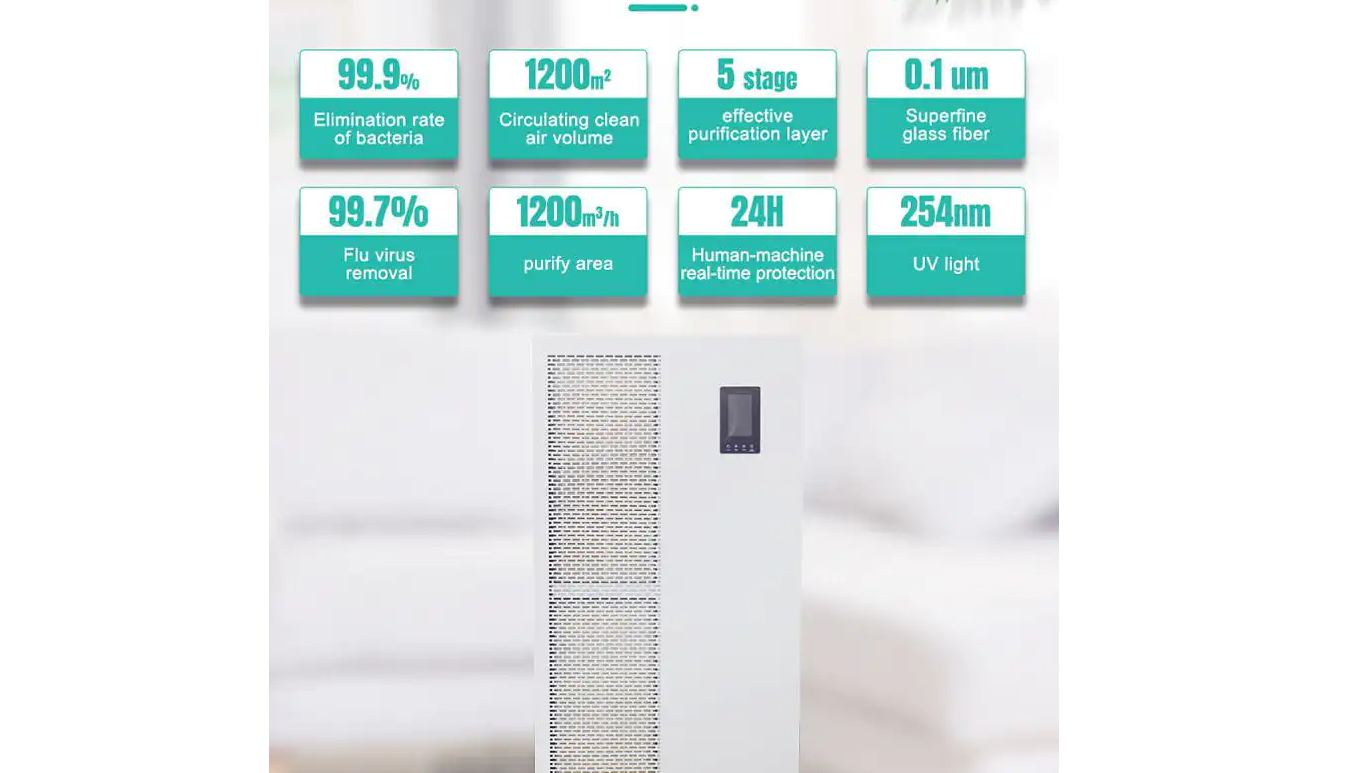
Viruses on their own are extremely small, but they are rarely airborne in isolation. In real conditions, viral particles typically travel attached to respiratory droplets or aerosols, which are considerably larger than a single virus and fall within the size range that HEPA filtration handles effectively. Because of this, a medical grade air purifier fitted with H13 or H14 filtration can capture a large share of virus carrying droplets as they pass through the filter, even though the filter is not marketed as a direct antiviral treatment.
Some medical air purifier models add a UV-C lamp stage positioned inside the airflow path, intended to act on airborne microorganisms in addition to physical filtration. Effectiveness of any UV stage depends on exposure time, lamp intensity, and airflow speed past the light source, so UV is generally treated as a supporting layer rather than a replacement for HEPA filtration. In healthcare settings, an air purifier for operating room use is typically paired with the room's existing ventilation and air change strategy rather than used as a standalone solution.
Sizing an Air Purifier for Healthcare and Hospital Spaces
Hospital air purifier planning generally starts with air changes per hour, a measure of how many times the full volume of air in a room is cycled through filtration within one hour. Rooms with higher infection control needs are commonly specified with a higher air change target than general patient areas, which is one reason equipment sizing differs so much between an operating theater and a waiting room.
Chart 2. Commonly referenced air changes per hour by hospital space type, shown as a general planning guide
What size air purifier does a hospital need is a question best answered room by room rather than with one figure for the whole building. A treatment room, an isolation room, and a shared waiting area each call for a different clean air delivery rate, and a portable medical air purifier chosen for a small consultation room will usually be undersized if moved into a larger open ward without a matching increase in airflow capacity.
How Quickly a Purifier Reduces Particle Counts
Once a purifier is switched on, particle counts in a closed room fall gradually rather than instantly, since the reduction depends on how many times the room air passes through the filter. A unit with a higher clean air delivery rate relative to room size will show a faster drop in particle concentration than a lower output unit placed in the same space.
Chart 3. General pattern of particle count reduction over one hour, comparing a higher output and lower output purifier in the same room
The practical takeaway is that purifier placement and continuous operation matter as much as the rated specification on the box. A medical air purifier left running throughout a shift, positioned so air can circulate freely around the intake and outlet, tends to keep particle counts lower and steadier than a unit that is repeatedly switched on and off or placed in a corner where airflow is restricted by furniture or equipment.
Medical Grade Versus Standard Household Air Purifiers
Not every air purifier is built for the same setting, and the differences go beyond filter grade alone. The radar chart below compares a medical grade air purifier against a standard household unit across five practical factors that matter when choosing equipment for a clinical or home environment.
Chart 4. General comparison of medical grade and standard household air purifiers across five practical factors
As shown above, a medical grade air purifier generally scores higher on filtration efficiency and clinical suitability, reflecting its tighter HEPA grade and construction intended for continuous duty in treatment areas. A standard household unit often scores a little better on noise control, since domestic models are commonly tuned for bedrooms and living spaces where quiet operation is a higher priority than maximum filtration grade.
Where Medical Air Purifiers Are Used
Hospitals and clinics use medical air purifiers across a range of departments, each with slightly different priorities. An air purifier for operating room use is typically specified with H14 filtration and higher airflow to support strict infection control near procedure areas. Isolation rooms and infectious disease wards commonly rely on similar high grade filtration paired with directional airflow planning. General wards, outpatient waiting areas, dental clinics, and elder care facilities often use H13 or True HEPA units, balancing filtration performance with lower noise and easier day to day servicing.
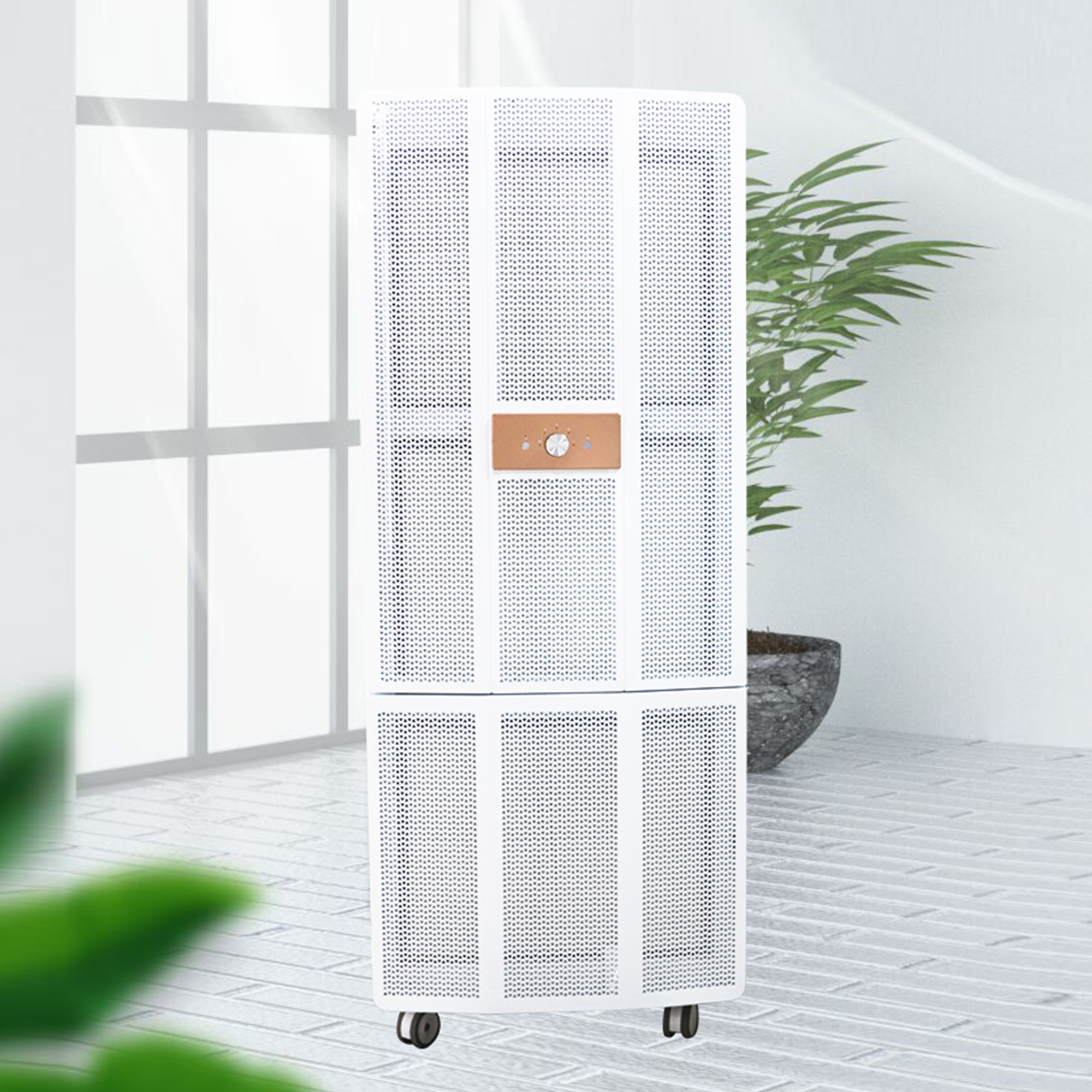
Outside of clinical buildings, healthcare air purifier technology has also moved into home care settings, where a portable medical air purifier supports patients recovering at home, individuals with compromised respiratory conditions, or households managing seasonal allergies. A medical air cleaner used in a home setting typically favors a compact footprint and simpler controls compared with the larger units built for continuous hospital duty.
Filter Replacement and Ongoing Maintenance
How often HEPA filters should be replaced depends on usage hours, room particle load, and filter grade, but most manufacturers publish a general interval as a starting point for planning. As a rough guide, pre-filters are typically checked and cleaned every few weeks, while the main HEPA stage is commonly reviewed every six to twelve months depending on how continuously the unit operates and how dusty the surrounding environment is.
| Filter Type | Typical Check Interval | Sign Replacement Is Needed |
|---|---|---|
| Pre-filter | Every 2 to 4 weeks | Visible dust buildup on the surface |
| HEPA H13 or H14 | Every 6 to 12 months | Reduced airflow or rising indicator alert |
| Activated carbon | Every 3 to 6 months | Returning odors despite normal airflow |
Regarding UV-C stages, most manufacturers position the lamp inside the housing so it is not visible during normal operation, which limits direct skin and eye exposure while the unit is running. As with any electrical appliance, following the manufacturer instructions for lamp handling during filter changes is the main safety practice worth keeping in mind.
Sourcing Medical Air Purifiers From a Manufacturing Company
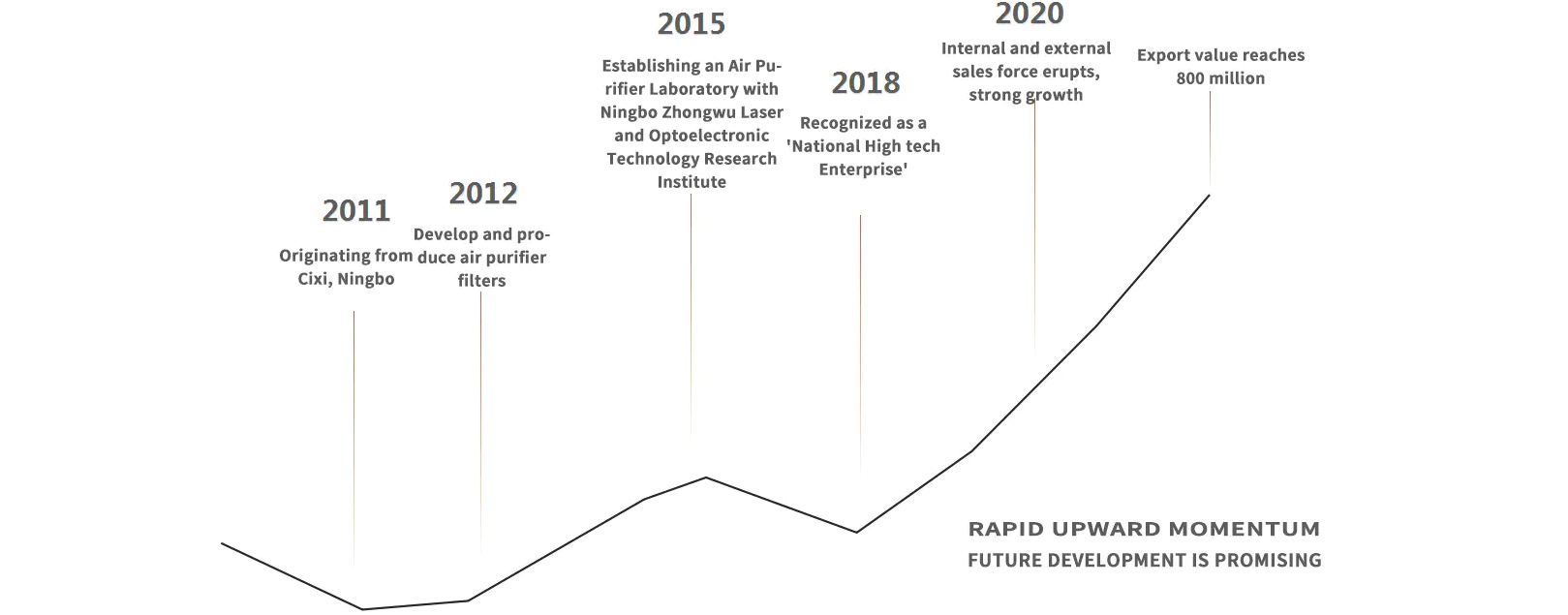
Distributors, healthcare suppliers, and appliance brands looking to bring a Medical Air Purifier line to market typically look for a manufacturing partner that can handle product development, filter engineering, and assembly under one roof rather than coordinating several separate suppliers. Ningbo Yinyu Purification Technology Co., Ltd. is a China based manufacturer and OEM factory for medical air purifiers, integrating production and trade across household appliances, household appliance parts, medical equipment, and disinfection equipment.
Established in 2011 and located in Cixi City, Ningbo, an area known for its long history in household appliance manufacturing, the company operates alongside two subsidiaries covering electric appliance production and medical technology development. Yinyu has grown into a comprehensive industrial and trade enterprise spanning product research and development, mold development, filter manufacturing, plastic injection molding, and finished product assembly, all coordinated internally rather than outsourced piece by piece.
The company maintains an in house testing lab with inspection equipment used to check units throughout production, and reports an annual production capacity of over 300 thousand units, allowing it to support customers with different purchase volumes, from smaller trial orders to larger recurring supply programs. For businesses planning to bring a Medical Purifier product to market under their own brand, working with a manufacturer that already handles filter design, molding, and assembly internally generally shortens the development cycle compared with sourcing components from multiple separate vendors.
Frequently Asked Questions
What Is a Medical Air Purifier
A medical air purifier is an air cleaning unit built around medical grade HEPA filtration, typically H13 or H14, designed for continuous use in clinical spaces such as treatment rooms, wards, and procedure areas.
How Do Medical Air Purifiers Work
They draw room air through a pre-filter, then a HEPA filter that captures fine particles, and often an activated carbon layer, with some models adding a UV-C stage to further treat the air passing through.
Are HEPA Air Purifiers Effective in Hospitals
HEPA filtration is widely used in hospitals because it captures a very high share of fine airborne particles, including many respiratory droplets, when the unit is properly sized for the room and kept running consistently.
Can Air Purifiers Remove Viruses
Air purifiers cannot target a single virus directly, but since viral particles typically travel on larger respiratory droplets, HEPA filtration captures a large share of these droplets as air passes through the filter.
What Is a Medical Grade HEPA Filter
A medical grade HEPA filter refers to H13 or H14 classification under the EN 1822 standard, capturing at least 99.95 percent or 99.995 percent of particles at 0.3 micron, respectively.
Do Hospitals Use Air Purifiers
Yes, many hospitals use portable or fixed air purifiers to supplement existing ventilation, particularly in isolation rooms, procedure areas, and spaces where additional filtration supports infection control practices.
What Is the Difference Between HEPA H13 and H14
H13 captures at least 99.95 percent of particles at 0.3 micron, while H14 captures at least 99.995 percent, making H14 the tighter grade commonly specified for operating rooms and isolation areas.
How Often Should HEPA Filters Be Replaced
As a general guide, HEPA filters are commonly reviewed every six to twelve months depending on usage hours and room particle load, while pre-filters are checked more frequently, roughly every two to four weeks.
Are UV Air Purifiers Safe
UV-C lamps used in air purifiers are generally housed inside the unit so they are not exposed during normal operation, and following manufacturer guidance during filter changes is the main safety consideration.
What Size Air Purifier Does a Hospital Need
Sizing depends on room type and target air changes per hour, with operating rooms and isolation spaces generally needing a higher clean air delivery rate than general wards or waiting areas.