EN
 English
 中文简体


A wok of fish curry, a hard sear at 200 °C, and twenty minutes later the smell has settled into the sofa cushions. The purifier in the corner is running at maximum, and the HEPA filter is doing exactly what it was designed to do: trapping particles. It is doing nothing measurable about the smell.
That is the first thing to get straight about air purifiers for odors. Smell is chemistry, not dust. Molecules of acrolein, ammonia, hydrogen sulfide or the terpenes drifting off a diffuser are thousands of times smaller than the fibres of a HEPA filter, and they pass straight through. What captures them is a gas-phase medium, almost always activated carbon, and two things decide the outcome: how many grams of that medium the unit carries, and how long the air actually spends in contact with it. Get either wrong and the smell comes back an hour after you switch the machine off.
Content
- 1 Three variables decide whether an odor problem is solved
- 2 Which gas-phase media earn their space in the filter stack
- 3 How much carbon a room really needs
- 4 Contact time and air changes: the maths behind a smell that comes back
- 5 Build a filter stack that matches the odor source
- 6 Placement and operating habits that decide the outcome
- 7 Maintenance: how to tell when the carbon is finished
- 8 For brands: what to write into an odor-control purifier brief
- 9 Frequently asked questions
Three variables decide whether an odor problem is solved
Particle CADR tells you almost nothing about odor performance. A unit can post an excellent clean air delivery rate for dust and still fail badly on cooking fumes. Three numbers matter instead.
- Media mass. Carbon works by holding molecules on its internal surface. A cartridge with 250 g of carbon has a small sponge; a bed with 1,200 g has a large one. Mass sets how long the filter lasts before breakthrough, not how fast it cleans.
- Contact time. Gas molecules need to sit against the carbon long enough to be captured. Push too much air through a thin bed and odours pass through untouched, which is why some boost modes make the smell worse by stirring the room without adsorbing anything.
- Air exchange rate. How many times per hour the purifier turns over the room volume. This sets how quickly an odor concentration drops, and it is calculated from CADR and room volume, not taken from a label.
Conclusion first: for odors, buy media mass and dwell time, then check the fan. Everything else is secondary.
Which gas-phase media earn their space in the filter stack
Not all "carbon filters" are the same product. The five options below cover nearly every residential and clinical odor problem, and they behave very differently under humidity, heat and continuous airflow.
| Media | Best against | Practical strength | What to check |
|---|---|---|---|
| Granular activated carbon (pelletized) | Cooking VOCs, smoke, pet odour, solvents | High capacity per gram, easy to top up, predictable pressure drop | Actual gram weight, iodine number, dust level, whether the bed can be refilled |
| Carbon cloth or felt | Light household odours, low-level ozone | Very thin, works at low pressure drop, fits tight housings | Typically only a few grams of media; service life is short in a kitchen |
| Zeolite molecular sieve | Ammonia and amines from litter trays, pet bedding, some cleaning agents | Better than plain carbon on small polar molecules | Needs heat to regenerate; confirm the grade and the binder used |
| Cold catalyst (catalytic oxidation) | Formaldehyde, acetaldehyde, light aldehydes from new furniture | Converts gases instead of storing them, so life is longer than a saturated bed | Needs good face contact; effectiveness drops sharply at high face velocity |
| Ionization or plasma stage | Some odorous gases, airborne bacteria | Low pressure drop, no media to replace | Ozone by-product; California limits air cleaners to 50 ppb, so ask for a third-party ozone report |
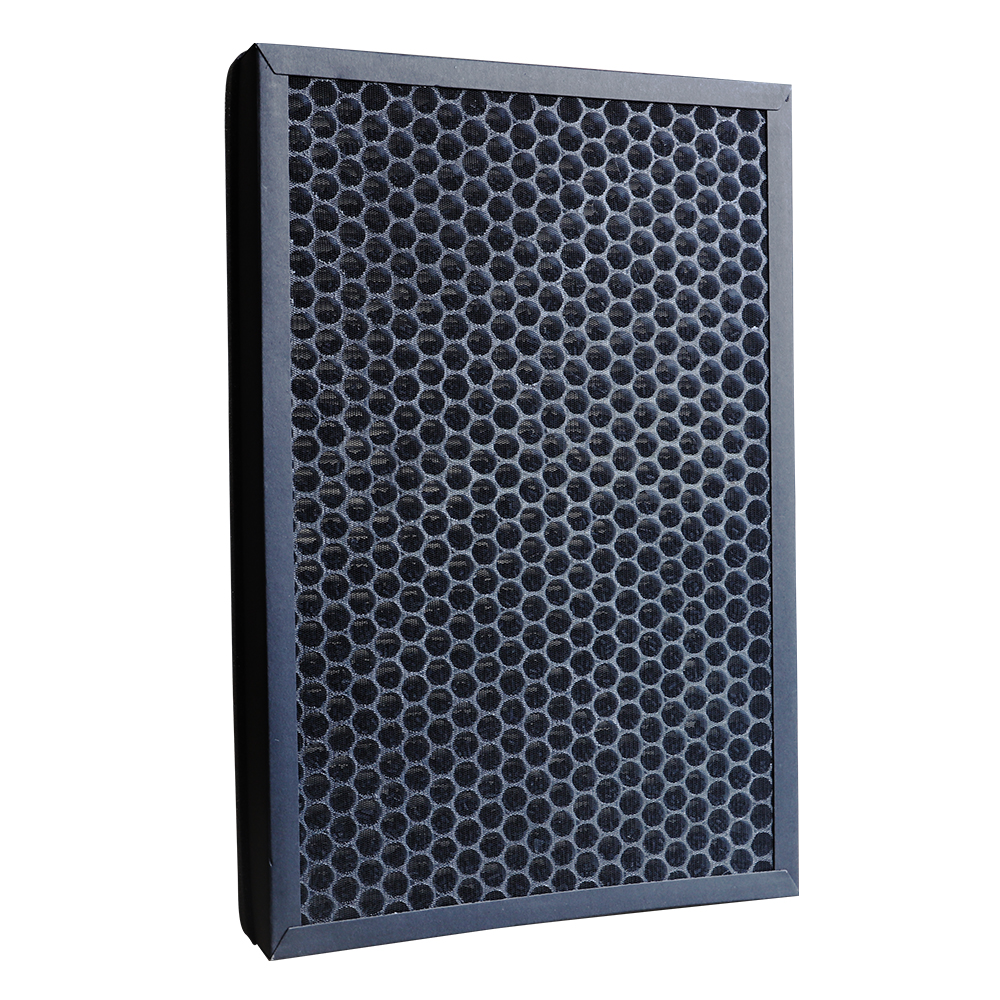 OEM Cold Catalyst Filter and Pre-FilterCustomizable low-resistance pre-filter with a cold catalyst stage for formaldehyde, ammonia and TVOC removal in air purifier and HVAC designs.View Product →
The practical lesson from our own filter line: a strong particle stage plus a weak gas stage is the most common failure mode in odor complaints. If a housing has room for only a thin cloth pad, the design is a bedroom unit, not a kitchen unit.
How much carbon a room really needs
There is no official standard for "odor CADR", so manufacturers size the gas stage by experience. Across our OEM projects, the working ranges below hold up well for homes with normal humidity and a filter changed on schedule.
Two things move a household up that scale. The first is cooking frequency: an open-plan kitchen where oil is used daily belongs in the third row, not the first. The second is humidity. Water vapour competes with odour molecules for the same pores, so a 1,000 g bed in a steamy kitchen behaves like a much smaller one. Real usable capacity is always below the laboratory figure quoted for virgin carbon.
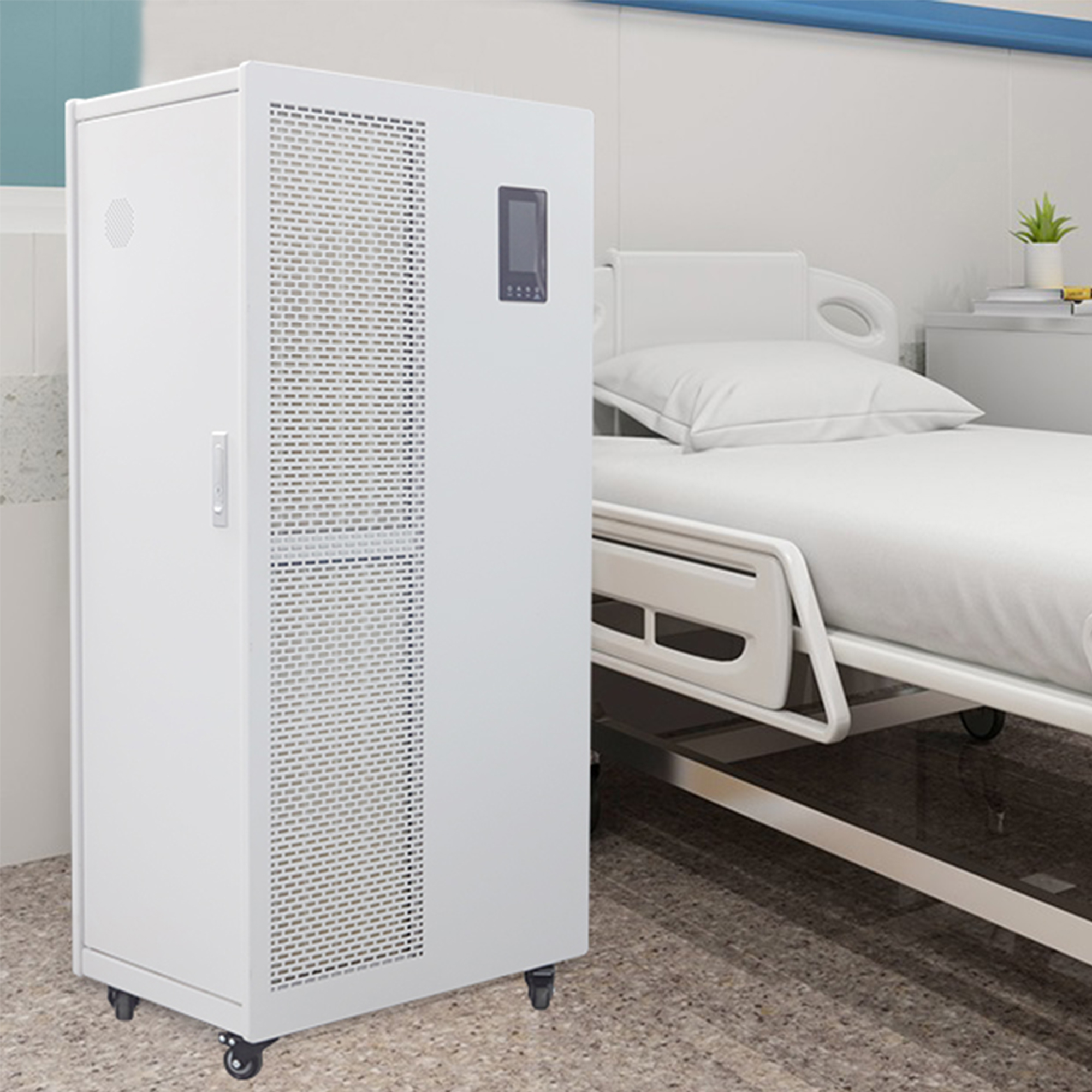
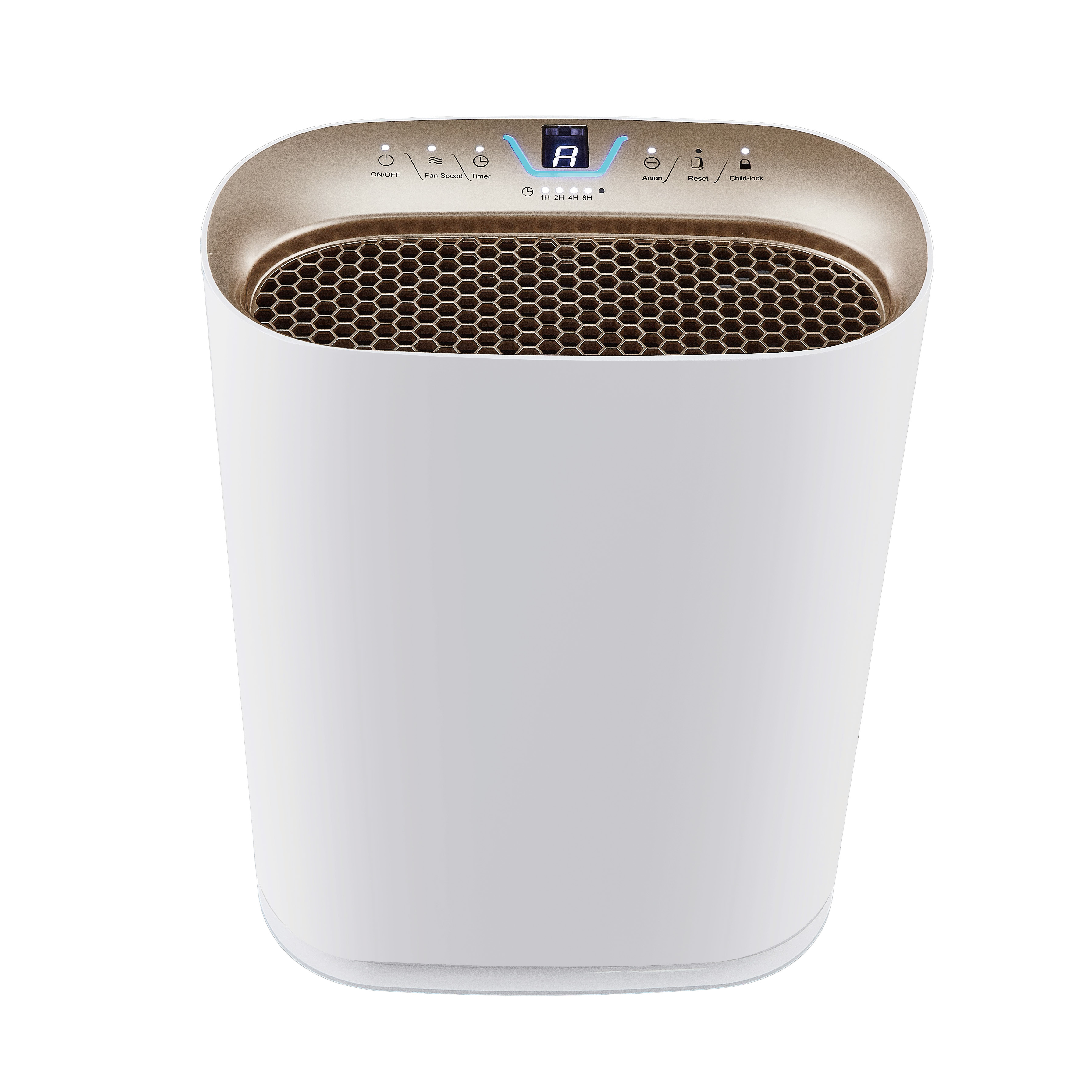 BKJ-300 Medical Air Purifier for RoomsA complete 36㎡ purifier with 300m³/h CADR, touch controls, ion control and filter reminder for formaldehyde and general indoor air cleaning.View Product →
Where space allows, a refillable cartridge is worth more than a bigger disposable one. Our own bulk media is supplied as activated carbon pellets precisely because loose fill can be topped up and weighed, while sealed cartridges hide how much media is actually inside.
Contact time and air changes: the maths behind a smell that comes back
Air changes per hour is simply the unit's CADR divided by the room volume, in the same units. A 30 m³ bedroom with a 300 m³/h unit gets 10 air changes per hour. The same unit in an 80 m³ living room gets fewer than 4, which is why moving a purifier to a bigger room so often disappoints.
Read the curves as a planning tool, not a promise. At 4 air changes, roughly a third of the initial odour is left after 15 minutes; at 12, it is close to 5%. But textiles, plaster and upholstery act as a reservoir, re-releasing volatiles for hours, so the practical routine is a short burst on high right after cooking, followed by a long, quiet run at low speed to keep the concentration down. Continuous low-speed operation also keeps the carbon working steadily instead of being drenched with a concentrated odour slug once a day.
Build a filter stack that matches the odor source
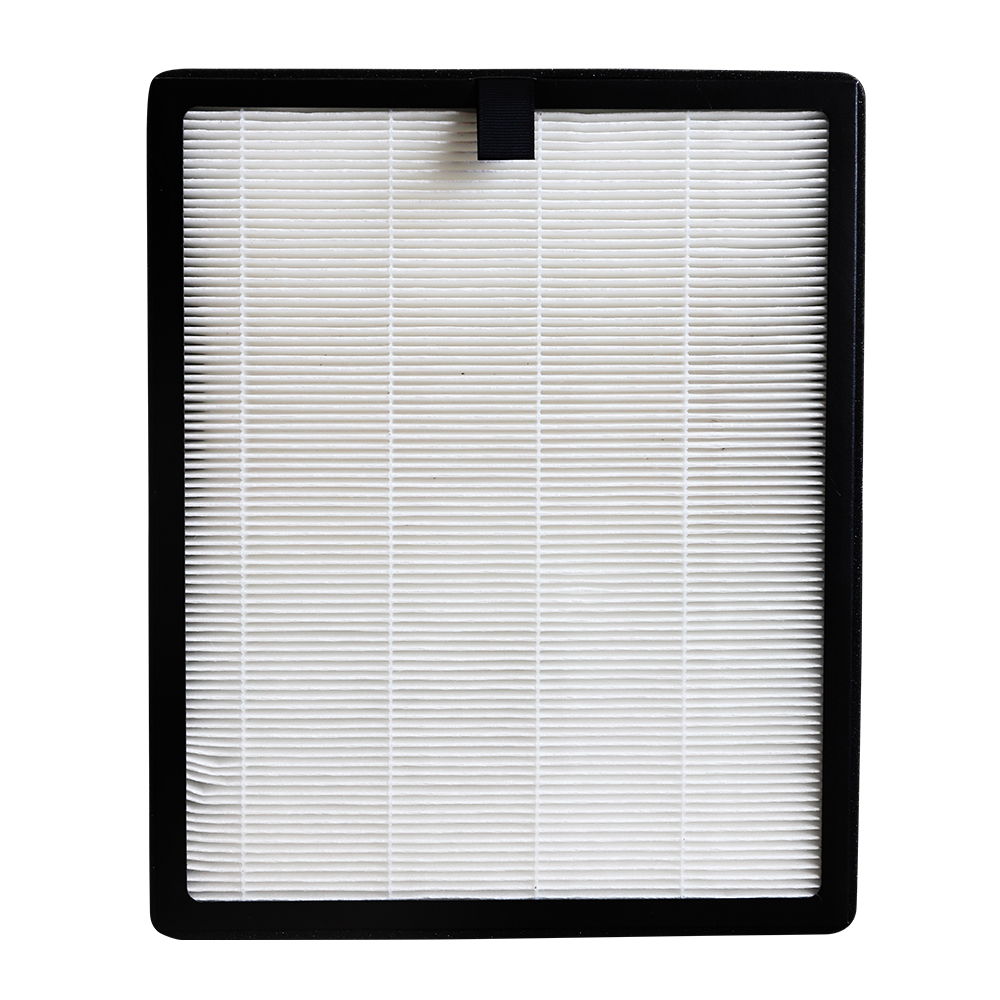 HEPA H13 Replacement Air Purifier FilterA customizable True HEPA H13 filter for air purifiers, rated to capture 99.95% of particles down to 0.3 microns, including dust, pollen and pet dander.View Product →
The order matters because each stage protects the next. A washable pre-filter keeps lint and cooking grease off the HEPA, grease that would otherwise coat the carbon and block its pores permanently. The carbon bed goes after the HEPA so it is not asked to filter dust, and the catalytic stage sits last, where it sees the gases that survived the carbon. Matching that stack to the source is the practical step:
- Daily frying and wok cooking: carbon of 800 g or more, 8 air changes or above, unit placed within 2 m of the hob but never directly over a flame.
- Pets and litter trays: ammonia is small and polar, so pair carbon with a zeolite stage rather than doubling the carbon alone.
- Tobacco smoke: the largest carbon mass you can accommodate plus a pre-filter changed monthly, since tar loads the first stage fast.
- Musty basement or damp wall: fix the moisture source first. Carbon handles the musty volatiles, but mould will keep producing them above 60% relative humidity.
- New furniture and formaldehyde: catalytic media plus carbon, run continuously at low speed for weeks rather than in daily bursts.
Placement and operating habits that decide the outcome
- Put the unit between the odor source and the people, not in a corner behind a sofa. Recirculation short-circuits when the intake faces a wall.
- Keep 20–30 cm clearance on all sides. Blocked intakes cut airflow and raise face velocity through the carbon, which shortens contact time exactly when you need it.
- Run boost for 10–15 minutes after cooking, then drop to low speed for several hours. Odours desorb from surfaces long after the pan is clean.
- Use the range hood as well. Extraction removes the plume at the source; the purifier handles what escapes.
- Close windows during boost. Dilution with outdoor air feels helpful but slows the concentration drop the purifier is producing.
- Keep interior doors open on the path between the purifier and the kitchen, or place a second unit in the kitchen itself.
Maintenance: how to tell when the carbon is finished
Carbon fails quietly. There is no indicator light that measures saturation, and a clogged HEPA changes the airflow before the gas stage gives up. Use these signals instead.
- Odour returns within minutes of switching the unit off, while it was fine a month ago.
- The unit feels lighter than a new cartridge of the same model, or a refillable bed has visibly settled.
- Airflow at the outlet has dropped noticeably, which usually means the pre-filter or HEPA is loaded, not the carbon.
- Replacement intervals: three to six months for a 1 kg carbon bed in daily cooking, six to twelve months in a bedroom.
Never wash activated carbon. Rinsing removes the adsorbed compounds from the surface only partially and leaves the pores full of water, and a damp carbon bed becomes a microbial habitat. Also resist the temptation to stretch a HEPA to match the carbon schedule: if the HEPA is still within its pressure-drop limit, replace the gas stage alone.
For brands: what to write into an odor-control purifier brief
Most odor complaints we investigate trace back to a specification that never mentioned the gas stage at all. A workable brief names the media, the mass in grams, the face velocity at maximum fan speed, the target gas list and the test method. Particle performance can be quoted to EN 1822 or ISO 16890, and the Chinese GB/T 18801 standard covers both particle and gas removal, which makes it a useful reference for formaldehyde and VOC claims.
- Carbon mass in grams, with a tolerance, and whether the cartridge must be refillable.
- Media specification: iodine number, pellet size, and whether a zeolite or catalytic stage is also required.
- Ozone limit for any ionizing stage, backed by a third-party report.
- Noise at low speed, because odor control depends on long continuous running.
- Filter access and a cartridge design that a customer can change without tools.
As a manufacturer that builds the filter media, the injection moulds and the finished unit in one plant in Ningbo, we usually start odor projects from the gas stage backwards: choose the media and mass, then size the housing and fan around it. Details of that process are on our OEM purification factory page.