EN
 English
 中文简体


Two purifiers rated at the same 300 m³/h can leave a bedroom at very different PM 2.5 levels, and the gap almost always sits in the filter rather than in the fan. Before comparing brands, compare three filter-side numbers: the particle class of the media, the pressure drop at your airflow, and how tightly the media is sealed into its frame.
The short version for homes and clinics: an H13-class HEPA stage is the practical sweet spot for PM 2.5. H14 cuts penetration by a further factor of ten but costs airflow and money; H11 saves pressure but gives up roughly an order of magnitude in capture. A well-sealed H13 will beat a leaking H14 in a real room.
The rest of this guide is a buyer's checklist: what PM 2.5 actually is at particle level, which standards measure it, how to size a filter to a room, and what to verify before ordering replacement cartridges or a container load of OEM filters.
Content
- 1 PM 2.5 Is a Particle-Size Problem Before It Is a Filter Problem
- 2 Filter Class Sets Efficiency; Pressure Drop Decides Whether You Feel It
- 3 Size the Filter to the Room, Not to the Label
- 4 Media Types: What You Are Actually Buying
- 5 Replacement Filters: The Grade Is Easy to Print, the Fit Is Not
- 6 What to Ask a Filter Supplier Before You Commit
- 7 Frequently Asked Questions About Air Filters for PM 2.5
- 7.1 Q1: How often should I replace an air filter for PM 2.5?
- 7.2 Q2: Is a HEPA H13 filter enough to remove PM 2.5?
- 7.3 Q3: Can I wash a HEPA filter instead of replacing it?
- 7.4 Q4: What CADR air purifier do I need for a 30 m² bedroom?
- 7.5 Q5: Why is my PM 2.5 reading still high after replacing the filter?
- 7.6 Q6: Do air purifiers remove PM 2.5 from cooking fumes and wildfire smoke?
PM 2.5 Is a Particle-Size Problem Before It Is a Filter Problem
PM 2.5 covers particles with an aerodynamic diameter of 2.5 micrometres or less. That includes the visible haze from cooking oil at high heat, candles, incense, toasting and wildfire smoke, but also the far smaller ultrafine fraction below 0.1 µm produced by gas burners, laser printers and vehicle exhaust.
Here is the counter-intuitive part that most marketing copy hides: 2.5 µm is not the hardest size to catch. Filtration efficiency dips at the most penetrating particle size (MPPS), which for most fibrous media falls between roughly 0.1 µm and 0.3 µm, where diffusion and interception are both weak. That is why EN 1822 and ISO 29463 test HEPA media at MPPS rather than at a nominal 0.3 µm, and why a filter advertised as "99% at PM 2.5" may score noticeably lower on the particles that actually reach deep lung tissue.
For whole-building ventilation the benchmark is different again. ISO 16890 classifies general ventilation filters as ePM10, ePM2.5 and ePM1 by mass removal of the corresponding size fraction, and the ePM2.5 class requires at least 50% removal. A room purifier and an HVAC filter therefore use different yardsticks for the same pollutant, and their ratings are not interchangeable.
| Class | Efficiency at MPPS | Where it fits | Main trade-off |
|---|---|---|---|
| ISO 16890 ePM2.5 | At least 50% of PM 2.5 by mass | Central ventilation, HVAC intake | Cheap and high-flow, but not a HEPA stage |
| EN 1822 E10 | At least 85% | Pre-filtration, low-demand cabinets | Minimal pressure drop, limited capture |
| EN 1822 H11 / E11 | At least 95% | Consumer purifiers using electret media | Low resistance, but charge decays over time |
| EN 1822 H13 (ISO 35H) | At least 99.95% | Bedrooms, clinics, allergy and asthma rooms | Moderate pressure drop and moderate cost |
| EN 1822 H14 (ISO 45H) | At least 99.995% | Cleanrooms, isolation rooms, medical suites | Highest pressure drop, highest unit cost |
Filter Class Sets Efficiency; Pressure Drop Decides Whether You Feel It
Upgrading from H11 to H13 typically multiplies media resistance several times over. If the fan curve cannot cover that extra resistance, airflow falls, and the clean air delivery rate can drop even though the media is objectively better. The chart below shows typical resistance values reported by media suppliers at rated airflow, stacked the way a real filter pack stacks them.
Sealing is the second half of the story, and it is the part buyers cannot see online. A 2 mm gap at the frame corner can bypass more particles than the media itself captures, because bypass air is completely unfiltered. Look for continuous gasket foam, potting compound or ultrasonic welds around the pleat pack, and check whether the cartridge seats with a positive compression rather than simply sliding into a slot.
This is why grade alone misleads. In chamber tests, a well-sealed H13 pack routinely outperforms a loosely fitted H14 pack at the same fan speed, because the leak path dominates the result. When you request samples, ask for a leak test or a smoke visualisation at the frame joint, not just a media efficiency certificate.
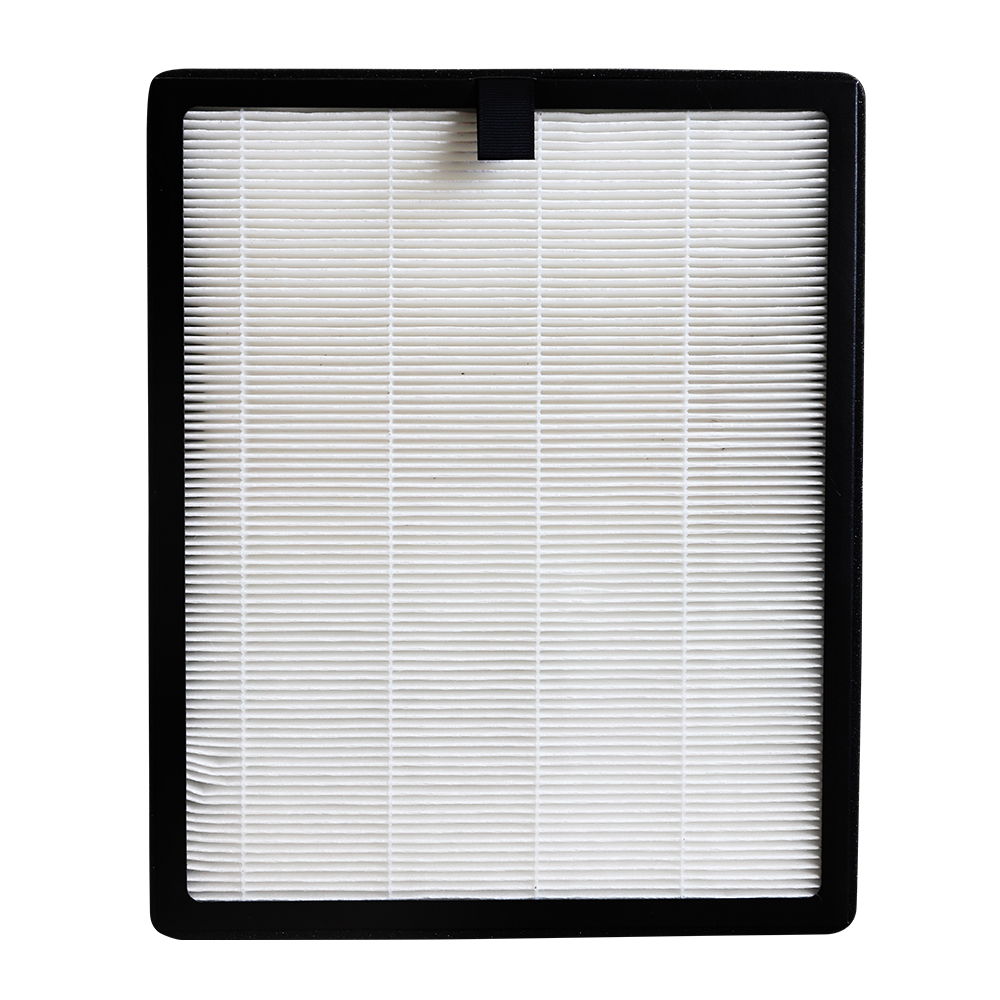 H13 Replacement HEPA Filter for Air Purifiers and Household UseCustomizable true HEPA cartridge capturing 99.95% of particles to 0.3 microns, suited to replacement use where sealed fit and room CADR matter.View Product →
Size the Filter to the Room, Not to the Label
CADR is the number that ties a filter to a room. It is a flow rate rather than a percentage, so the same H13 cartridge can be perfectly adequate in a 12 m² bedroom and clearly undersized in an open-plan living room. The arithmetic is simple: required CADR in m³/h equals room volume in m³ multiplied by the air changes per hour you want. Allergen and smoke control usually targets 4.8 ACH, which is the basis for the chart below; general odour control can work at roughly half that rate.
AHAM's familiar shortcut says the same thing in imperial units: choose a CADR no lower than two thirds of the room area in square feet for particle removal, assuming a normal ceiling height. It is a rule of thumb, not a guarantee, but it filters out most underpowered machines before you read another spec sheet.
China's GB/T 18801 adds a second axis that many spec sheets hide: CCM, or cumulative clean mass, graded P1 to P4 for particulate. A P4 filter holds at least 12,000 mg of particulate before efficiency falls below the threshold, which is roughly the difference between a cartridge that survives one winter and one that survives three. Always read CCM next to CADR; a high CADR with a thin pleat pack simply means you will replace it sooner.
Media Types: What You Are Actually Buying
Media choice explains why two filters carrying the same H13 label behave differently after a month of service. The radar comparison below scores the two mainstream options on the five parameters that matter most in residential and light-commercial duty.
- Electret melt-blown polypropylene: low resistance and low cost. Capture depends partly on an embedded electrostatic charge, which fades with humidity and oily aerosol from cooking.
- Glass-fibre HEPA: mechanical capture with no charge to lose, stable efficiency and good temperature tolerance, but higher pressure drop and higher cost per square metre.
- Nanofibre: very high efficiency at low basis weight, useful where depth is limited, but more sensitive to moisture. A 2019 study in Scientific Reports found that relative humidity measurably changes PM removal in electrospun nanofibre media.
- Activated carbon: contributes nothing to PM 2.5 removal and adds roughly 60 to 100 Pa of resistance. It earns its place only when odours, VOCs or ozone are also a concern.
Replacement Filters: The Grade Is Easy to Print, the Fit Is Not
Replacement time is where most PM 2.5 performance is quietly lost. A cartridge that is 1 mm too thin will not compress its gasket, and a pleat pack with 30% less media area will load faster and show a steeper efficiency decline over the same interval. Measure the outer diameter, the inner bore, the overall height and the gasket thickness before ordering, and keep the tolerance within plus or minus 1 mm on the sealing faces.
Two practical rules apply. First, never wash a HEPA or nanofibre element; water collapses the pleat structure and, in electret media, destroys the charge. Second, treat a rising pressure drop rather than a fixed calendar date as the real replacement signal, because cooking frequency and outdoor pollution change filter life by a factor of two or more.
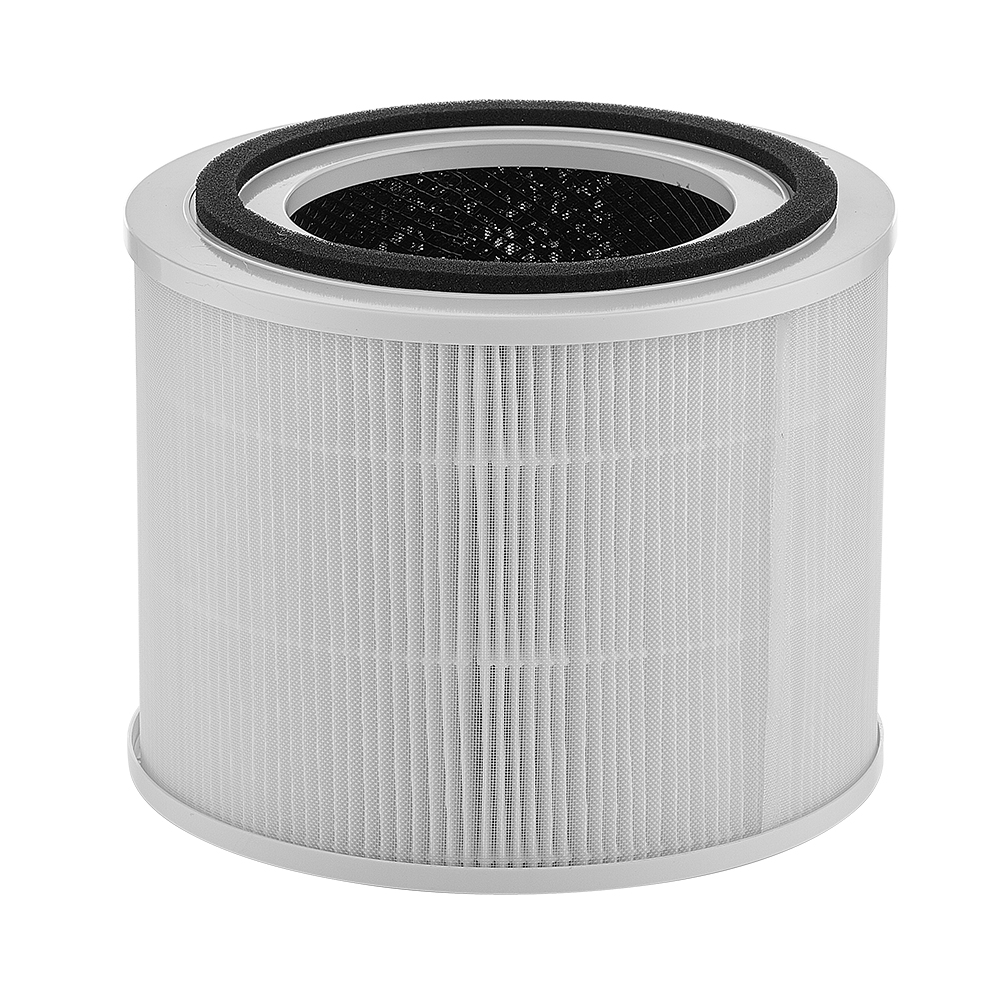 Customizable Round H13 HEPA Filter for OEM Air Purifier ProjectsOEM-ready H13 filter with selectable media and HEPA-plus-carbon or cold-catalyst combinations, sized to customer requirements for purifier or clean-plant use.View Product →
What to Ask a Filter Supplier Before You Commit
For OEM and ODM programmes, the specification conversation matters more than the catalogue page. A useful checklist for a first meeting looks like this:
- Batch test reports per EN 1822 or ISO 29463, measured at MPPS rather than at a nominal 0.3 µm.
- A pressure drop curve across the airflow range you actually intend to run, not a single point figure.
- Media origin, pleat count, pleat depth and effective media area per cartridge.
- Gasket or potting specification, plus a frame leak test method.
- Tooling ownership, MOQ, sampling lead time, and whether parts or complete units are shipped.
Suppliers with in-house media production can usually hold tighter tolerances than trading companies that resell imported rolls, because they control pleating and sealing on the same line. That vertical integration is also what makes custom filter manufacturing realistic at moderate volumes: pleat height, frame outline, gasket geometry and media grade can all be adjusted without changing suppliers mid-project.
Medical and cleanroom buyers push the requirement further. Projects that specify H14 filtration systems normally want documented batch efficiency, traceable media lots and a defined seal integrity test, because those installations are audited rather than simply inspected. For reference, Ningbo Yinyu Purification Technology, a Ningbo-based manufacturer founded in 2011, runs filter media production, injection moulding and final assembly in one facility and lists OEM cooperation with brands including TCL, Changhong, Qinyuan and Whirlpool in its public company profile.
 Customizable Air Purifier Filter Range with HEPA, Carbon, and Pre-Filter OptionsFactory-made HEPA, activated-carbon, cold-catalyst, and pre-filter combinations for purifiers and HVAC, with OEM sizing for replacement or project-specific filtration needs.View Product →
Frequently Asked Questions About Air Filters for PM 2.5
Q1: How often should I replace an air filter for PM 2.5?
Most residential HEPA cartridges last 6 to 12 months. In homes that cook daily or sit in heavy traffic or wildfire zones, expect 4 to 8 months, or replace when pressure drop rises and CADR falls noticeably.
Q2: Is a HEPA H13 filter enough to remove PM 2.5?
Yes. H13 captures at least 99.95% at the most penetrating particle size, which covers PM 2.5 with a wide margin. The limiting factor is usually airflow and sealing, not the media grade itself.
Q3: Can I wash a HEPA filter instead of replacing it?
No. Washing collapses the pleat structure and strips the electrostatic charge from electret media. Only pre-filters and some reusable mesh stages are designed to be rinsed and dried.
Q4: What CADR air purifier do I need for a 30 m² bedroom?
About 390 m³/h at 4.8 air changes per hour with a 2.7 m ceiling. If you want quieter operation on low speed, choose a higher CADR model and run it in the middle of its range.
Q5: Why is my PM 2.5 reading still high after replacing the filter?
Common causes are a poorly seated cartridge, a torn gasket, a dirty sensor inlet, or an undersized unit for the room. Check the seal first, then confirm the CADR matches the floor area.
Q6: Do air purifiers remove PM 2.5 from cooking fumes and wildfire smoke?
They remove the particulate fraction well when sized correctly, but they do not remove gases or odours unless an activated carbon stage is fitted. For smoke episodes, run at maximum speed and keep windows closed.