EN
 English
 中文简体


A shopper comparing a 5.5 L basket air fryer with a 15 L air fryer oven is not really weighing two cooking methods. Both push hot air across the food, and both brown it the way a convection oven does. What separates them is shape: a basket model keeps the fan and heating element a few centimetres above the food, while an air fryer oven spreads the same airflow across a wider, shelf-loaded cavity.
That single design choice ripples outward — batch size, browning speed, how often you shake, how much counter you surrender, and how long cleaning takes. Match the form factor to how you actually cook, and the rest of the specification sheet becomes much easier to read.
- Basket air fryer: fastest browning per item, small footprint, one working layer, two parts to wash.
- Air fryer oven: larger cavity, two racks at once, handles whole chickens, toast, baking and dehydration.
- Shared truth: both are forced-convection cookers, so recipes rarely transfer one-to-one between them.
Content
- 1 The Short Answer: Same Physics, Different Enclosure
- 2 Capacity: The Number That Decides Everything
- 3 Where the Air Actually Goes
- 4 Side-by-Side Comparison
- 5 What Actually Changes on the Plate
- 6 How to Choose Without Overbuying
- 7 For Brand Owners: The Specs That Decide the User Experience
- 8 Frequently Asked Questions
The Short Answer: Same Physics, Different Enclosure
Strip away the labels and both appliances are forced-convection ovens. A fan drives heated air over the food and removes the thin boundary layer of cooler air that normally insulates the surface. Moisture then evaporates faster, and browning starts at temperatures that would otherwise only dry the food out. That is why a spoonful of oil produces results most people read as fried.
Basket air fryer: short air path, high velocity
The element sits roughly 2 to 4 cm above the food and the fan pushes air straight down onto it. Because the chamber is small, the air loses very little heat on the way and velocity at the food surface stays high. The result is the fastest browning of the two designs, at the cost of a single working layer: stack food too deep and the bottom steams instead of crisping.
Air fryer oven: more volume, more loading options
An air fryer oven puts the same fan and elements into a 12 to 30 L box with a glass door and slide-in racks. The larger cross-section spreads the airflow, so velocity at any one point is lower. Browning per tray is a little gentler, delicate bakes are more forgiving, and because two racks can run at once, total output usually wins even when a single tray is slower.
Capacity: The Number That Decides Everything
Litres describe the cavity, not the food. A basket has to stay in one layer for even browning, so its practical capacity is roughly its basket floor. An oven-style unit can stack two racks and still circulate air, which is why the real gap between a 15 L oven and a 5.5 L basket is wider than the litre ratio suggests.
Footprint is the other half of the trade. A basket model typically occupies a 30 × 35 cm patch of counter and can be tucked under a cabinet. Oven-style units are closer to a small microwave in width and height, and most need clearance above the door so it can swing open without hitting the wall.
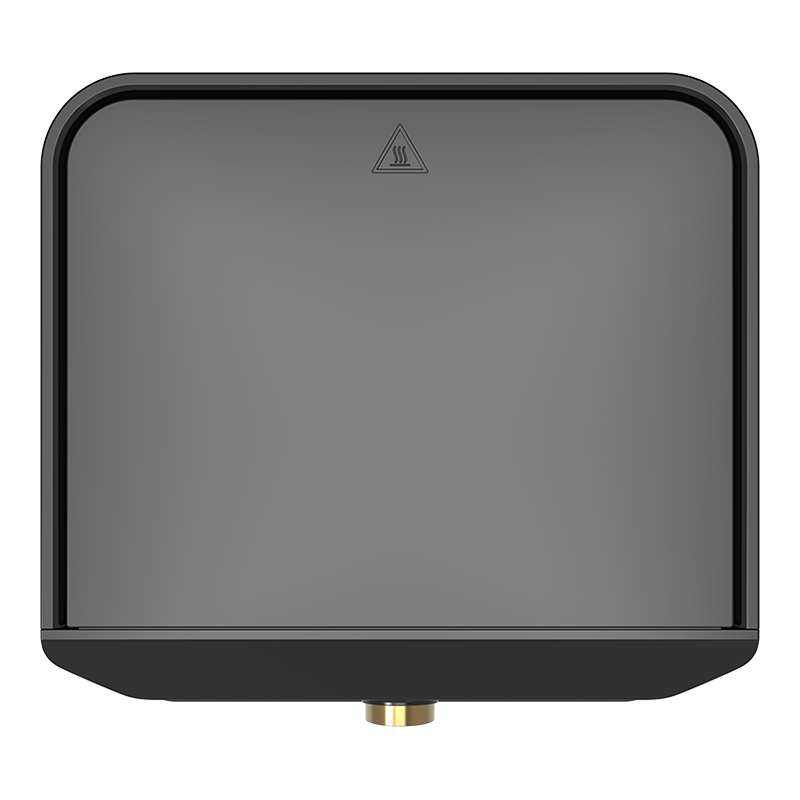 Large Capacity 15L Digital Air Fryer YYZG-1500ASFor larger households or batch roasting, this 15L model offers family-size capacity where a bigger basket may not suit the available counter space.View Product →
If your household runs to five or more, or you routinely roast a whole chicken or two trays of vegetables at once, a large-capacity model from our family-size air fryer range is the more practical starting point than a bigger basket.
Where the Air Actually Goes
Airflow explains most of the complaints people have after the first week. In a basket model the air enters from above, hits the food and returns up the sides, so anything that blocks the perforated plate — foil, a tight silicone liner, an overfilled basket — turns the cooker into a plain oven.
In an oven-style cavity the fan sits at the rear and air travels horizontally across the racks. That makes rack position matter: the middle position is the most even, the top browns fastest, and a tray pushed flat against the back wall blocks the return path. It also makes preheating worthwhile — three to five minutes lets the cavity and the elements stabilise before food goes in.
Side-by-Side Comparison
| Feature | Basket air fryer | Air fryer oven |
|---|---|---|
| Typical capacity | 1.8–8 L | 12–30 L |
| Loading style | Pull-out drawer, single layer | Two racks, door opens flat |
| Airflow | Top-down, high velocity | Rear fan, horizontal, lower velocity |
| Browning speed | Faster on small batches | Slightly slower per tray, more even |
| Best at | Fries, wings, reheats, sides | Whole chicken, baking, toast, dehydrating |
| Preheat needed | Rarely more than 2 minutes | Usually 3–5 minutes |
| Cleaning | Drawer plus crisper plate | Racks, drip tray, crumb tray, glass door |
| Counter footprint | Compact, fits under cabinets | Microwave-sized, needs door clearance |
What Actually Changes on the Plate
- Frozen fries: the basket wins on crispness because the food sits close to the fan in a thin layer. The oven version needs a single layer per rack and a mid-cook shuffle.
- Chicken wings: both cope well. The oven takes a bigger batch with less shaking, which matters when you are feeding a crowd.
- Whole chicken: oven territory. A basket cannot hold a bird without the skin pressing against the element guard.
- Cakes and bread: oven territory again. Unidirectional airflow from above gives basket-baked cakes a lopsided crown.
- Toast and reheating: the oven holds four slices flat; a basket cannot.
- Dehydrating: only oven-style units with a low-temperature mode handle this properly.
How to Choose Without Overbuying
- One or two people, mostly sides and reheats — a 3 to 4.5 L basket with a mechanical knob keeps controls simple and cleaning short.
- Three or four people, one-tray dinners — a 5.5 to 6 L basket, or a dual-basket if you want a protein and a vegetable cooking in parallel.
- Five or more, or batch cooking for the week — a 12 L and above oven-style unit, where two racks do the work of two basket rounds.
- Baking, toasting and dehydrating — only an oven-style cavity with top and bottom elements and a low-temperature setting earns its counter space.
For a four-person kitchen, a mid-size digital basket covers most weeknight cooking without crowding the counter. The 5.5 L class is the sweet spot for that job.
 5.5L Mechanical Air Fryer with 8 Smart MenusA 5.5L mid-size option for four-person kitchens, with knob controls, eight built-in menus and a non-stick drawer for routine weeknight cooking.View Product →
For single households, dorms or offices, a compact 1.8 L unit does the same work at half the footprint — useful when the alternative is not buying anything at all.
 Compact 1.8L Mini Air Fryer YYZG-200AFor single households, dorms or offices, this 1.8L mini air fryer pairs a small footprint with a digital panel and eight preset menus.View Product →
For Brand Owners: The Specs That Decide the User Experience
If you are sourcing rather than buying at retail, the difference between the two categories shows up in the development brief long before the packaging artwork. The details that move user satisfaction most are:
- Usable rack or basket area versus nominal litres — the number on the box rarely matches the number of portions.
- Element layout: top only, or top and bottom, which changes how a tray browns from underneath.
- Fan and duct design, plus noise at full power — the most common online complaint in this category.
- Coating specification and dishwasher tolerance, including any PFAS-free claim you intend to print.
- Control architecture: mechanical knob versus touch panel with presets, and how legible the display is at arm's length.
- Safety chain: thermal cut-out, cool-touch handle, door interlock, cord length.
- Certification set for the destination market, and packaging that survives a drop test.
Ningbo Yinyu builds air fryers from 1.8 L compact units to 15 L oven-style models, backed by in-house mould development, injection moulding and final assembly under ISO-certified manufacturing, with export experience across Europe, the Americas and Japan. Projects that need a modified cavity, a different control board or a CKD/SKD shipment usually begin with ODM product development.