EN
 English
 中文简体


You have 24 inches of free counter, a 6.5L air fryer box, and a family that wants dinner in 20 minutes. That is where most air fryer kitchen decisions are won or lost—not in the preset menu. The practical answer: fit the appliance to your counter and ventilation first, then choose capacity and controls. A 1,800W model with a blocked rear vent will perform worse than a 1,500W model with clear airflow and a properly sized basket.
Short answer: check rear and side clearance, compare usable basket dimensions rather than liters alone, and plan a path for steam and grease. Wattage and presets matter, but they are second-order details.
This guide is written from a manufacturer's perspective—we build air fryers and air-treatment equipment—so it focuses on the details that show up in real kitchens and in OEM specifications.
Content
- 1 Start With the Countertop, Not the Recipe
- 2 Match Capacity to the Work You Actually Do
- 3 Controls, Wattage, and the Tolerance That Matters
- 4 Smoke, Odor, and Grease: The Kitchen Air Problem
- 5 Cleaning That Protects the Coating and the Heating Element
- 6 For Brands and Buyers: What to Verify Before You Source
- 7 A 10-Minute Kitchen Fit Checklist
- 8 Air Fryer Kitchen FAQs
Start With the Countertop, Not the Recipe
Placement is the first performance decision. Air fryers are small convection ovens: they pull air in, heat it, and push it through the basket. If the rear or side vents sit close to a cabinet, the unit recirculates warm, moist air. Food browns unevenly, the exterior collects a grease film, and the appliance works harder.
Common owner manuals call for 4–6 in (10–15 cm) of rear clearance and 2–4 in (5–10 cm) on the sides; follow your model's numbers. Also check the overhead cabinet. A slide-out shelf can put the top of the unit within 12 in of a cabinet, which is tight for steam and heat. If you must use that space, run the hood or a window fan and pull the unit forward during cooking.
Electrical load is the second check. Many 5–6.5L models are rated 1,500–1,800W. At 120V, 1,800W draws 15A—close to a standard 15A circuit's limit. Do not share that circuit with a kettle, toaster, or coffee maker. Use a dedicated outlet and keep the cord away from the hot housing.
- Counter depth: confirm the unit fits with the basket fully open.
- Rear vent: keep it clear of the wall, not just the cabinet.
- Steam path: hood, window, or cross-flow; a closed corner is the worst spot.
- Surface: heat-resistant and level; never operate on a cloth.
Match Capacity to the Work You Actually Do
Buy for the batch you cook on a Tuesday, not the holiday crowd. Liter ratings are total cavity volume, not the amount of food you can brown in one layer. A 6.5L unit with a shallow basket can hold less usable food than a 5.5L unit with a wider, deeper basket. Ask for the internal basket dimensions, not just the liters.
| Capacity band | Best fit | What to check |
|---|---|---|
| 2–3.5L | 1–2 people; sides; reheating | Basket diameter, counter depth, cord length |
| 5–6.5L | 3–4 people; one-pan dinners | Rear clearance, wattage, preheat and shake prompts |
| 8–10L dual-basket | 4–5 people; two foods at once | Overall width, separate controls, cleaning access |
| 15L oven-style | 5+ people; batch cooking | Dedicated counter space, circuit load, storage |
Small kitchens and one- or two-person households usually do best with a 3–3.5L unit. It heats faster, stores easily, and fits a 12-in counter depth. The trade-off is batch size: fries for two may need two rounds if you want them crisp.
 3.6L Knob-Controlled Oil-Free Air FryerA compact oil-free air fryer with knob control, eight smart menus, and a nonstick drawer, suited to smaller households comparing countertop capacity.View Product →
For three or four people, a 5–6.5L model is the practical middle. Look for a basket wide enough to spread food in one layer, plus a preheat or shake reminder that fits your routine.
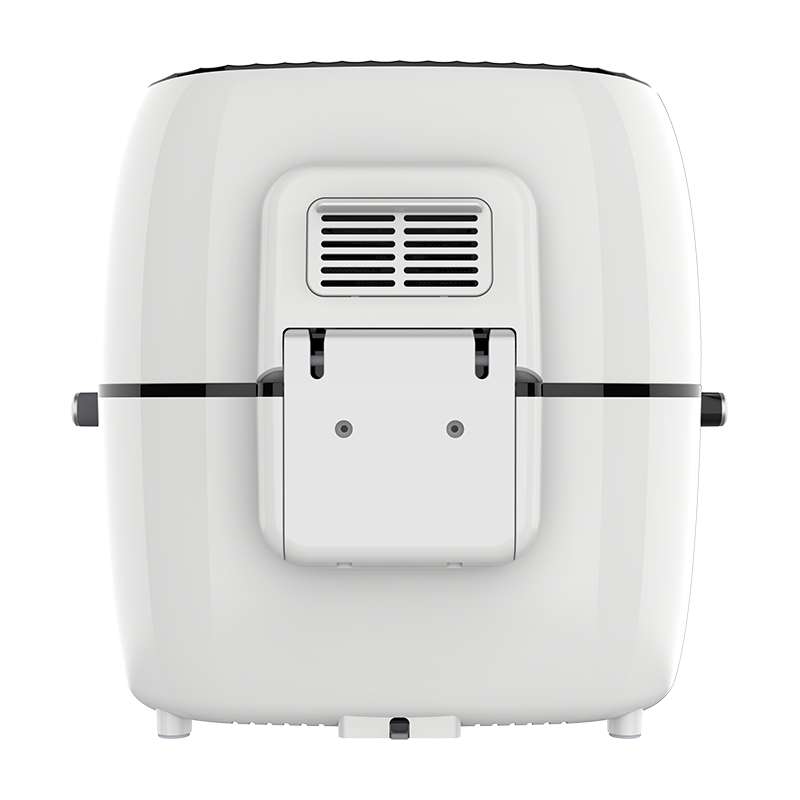 6.5L Touch-Control Air Fryer with Eight Smart MenusA practical mid-size choice for three or four people, with adjustable temperature, eight preset menus, and a nonstick cooking surface.View Product →
Large households, meal-preppers, and anyone cooking two components at once should look at 8–10L dual-basket or 15L oven-style units. They take real counter space and often need a dedicated circuit. Measure the full open-door or open-basket depth before you buy.
 15L Digital Air Fryer with Sliding DoorA large-capacity oven-style option for families or guests, featuring a sliding door, 0–30 minute timer, and automatic shut-off with ready alert.View Product →
Controls, Wattage, and the Tolerance That Matters
Digital does not automatically mean better. A stable thermostat, a responsive heating element, and a basket that promotes airflow matter more than a panel with 12 presets.
Mechanical dials are simple and repairable; the trade-off is setting accuracy. Digital controls repeat a setting more precisely, but low-cost sensors can still swing. For thin foods—fish, vegetables, pastry—a 10°C thermostat swing is more visible than for dense foods like chicken thighs. Ask for the control tolerance and test method if you are specifying a unit.
Wattage is about recovery, not just speed. A higher-wattage unit returns heat to the cavity faster after the basket is opened, but it also draws more current. Match the rating to the circuit and to the plug type in the destination market.
- Mechanical: fewer failure points, less precise setting.
- Digital: repeatable, but verify sensor tolerance.
- Dual-basket: good for two foods, more counter width.
- Oven-style: high batch capacity, slower heat-up.
Presets are shortcuts, not guarantees. Check whether the unit preheats, whether it reminds you to shake, and whether keep-warm holds a safe temperature. A window is useful for monitoring browning; it also adds a surface that needs cleaning.
Smoke, Odor, and Grease: The Kitchen Air Problem
Most “air fryer smoke” complaints are not a defect. They are fat, batter, or residue hitting a hot element. Wet batter, overcrowding, and a dirty rear vent are three common causes. Pat food dry, use a light oil coat rather than a pool, and leave space between pieces.
Ventilation is part of the cooking setup. Turn on the hood before you start, not after smoke appears. If you have no hood, open a window and use a fan to create cross-flow. A recirculating hood filters some grease but does not remove moisture or fine particles as effectively as exterior venting.
An air purifier with a HEPA filter and carbon media can reduce fine particles and cooking odors, but it is a supplement. Source control—clean element, correct load, clear vents—comes first. Do not place the purifier directly beside the air fryer exhaust; give both units room to breathe.
Safety note: if smoke persists, unplug the unit, let it cool, and inspect the element and basket. Do not keep cooking to “burn it off.”
Cleaning That Protects the Coating and the Heating Element
Cleaning is not cosmetic. Grease on the element smokes, and abrasive scrubbing shortens the life of the nonstick coating. A short cleaning routine prevents most smoke complaints and keeps the basket sliding smoothly.
| Task | Frequency | Method | Risk if skipped |
|---|---|---|---|
| Basket and crisper plate | After every use | Warm water, mild soap, soft sponge | Burned-on grease, smoke, coating damage |
| Heating element | Weekly or after fatty foods | Cool unit, damp cloth, no immersion | Smoke, odor, reduced airflow |
| Rear vent and gasket | Monthly | Soft brush or cloth | Restricted exhaust, uneven browning |
| Cord and plug | Monthly | Visual check for heat damage | Electrical risk |
Wait until the unit is cool before cleaning the element. A damp cloth on a warm element can warp or damage the coating. Never immerse the body in water. Dry the basket fully before storage; trapped moisture is a common cause of odor.
For Brands and Buyers: What to Verify Before You Source
If you are specifying an air fryer kitchen appliance for a brand, the consumer issues above become line-item requirements. The goal is not a longer feature list; it is fewer returns and fewer one-star reviews about smoke, uneven browning, or peeling coatings.
| Check | Why it matters | Evidence to ask for |
|---|---|---|
| Usable basket volume | Liter ratings can overstate one-layer capacity | Internal dimensions and food-load diagram |
| Thermostat tolerance | Wide swings cause uneven browning | Test method, sample size, acceptance band |
| Wattage and voltage | Circuit load and market compliance | Nameplate rating and voltage variants |
| Coating adhesion | Peeling drives returns and safety complaints | Abrasion and adhesion test reports |
| Vent and packaging design | Rear clearance and drop damage affect reviews | Clearance drawing, drop-test results |
| Out-of-box odor | Burn-off smell can be mistaken for a defect | Defined burn-off procedure and acceptance criteria |
For OEM/ODM programs, ask for the test method behind each claim, not just the result. A “nonstick” claim without an abrasion cycle count is hard to compare across suppliers. A wattage claim without voltage and tolerance is incomplete. And a capacity claim without usable basket dimensions is marketing, not engineering. Our ODM product development process starts with these definitions because they determine whether the finished unit fits a real kitchen.
A practical thermostat tolerance target for a premium program is a ±10°C band around the setpoint under defined test conditions; ±20°C is loose for consistent browning. Ask for the test conditions, the instrument, and the sample size. That is how a specification becomes a repeatable product.
A 10-Minute Kitchen Fit Checklist
Before you buy or place an air fryer, run this check:
- Measure counter depth with the basket fully open.
- Confirm rear and side clearance from the owner's manual.
- Check the circuit and whether the plug matches your outlet.
- Compare usable basket dimensions, not just liters.
- Plan a ventilation path for steam and grease.
- Confirm the cleaning routine you will actually do.
The best air fryer kitchen setup is boring: clear vents, the right batch size, stable heat, and a clean basket. Get those right, and the presets become a convenience rather than a crutch.
Air Fryer Kitchen FAQs
What size air fryer fits a family of four?
A 5–6.5L model is the practical starting point for one batch of protein and vegetables. If you often cook two foods at once, look at an 8–10L dual-basket or a 15L oven-style unit. Check basket dimensions before the liter rating.
Do air fryers need ventilation?
Yes. The rear and side vents need clearance, and the steam and grease need a path out of the kitchen. A hood, window, or cross-flow fan helps; a tight corner does not.
Why does my air fryer smoke?
Usually fat, wet batter, overcrowding, or residue on the heating element. Stop the unit, unplug it, let it cool, and clean the element and basket. If smoke returns on a clean unit, contact the manufacturer.
Is an air fryer cheaper to run than an oven?
For small batches, often yes, because the cavity is smaller and preheat is shorter. For large batches, an oven may be more efficient. Compare wattage, cooking time, and the amount you can cook in one load.
Can I put an air fryer under a kitchen cabinet?
Only if the manual allows the clearance and the surface is heat-resistant. Steam and grease can damage cabinet finishes over time. Pull the unit forward during cooking and use ventilation.
How do I clean an air fryer basket without ruining the coating?
Use warm water, mild dish soap, and a soft sponge after the basket cools. Avoid metal scouring pads and abrasive cleaners. Dry fully before storage.